
- HOME
- INDIA
- WORLD
- BUSINESS
- STATES
- LAW & JUSTICE
- ENTERTAINMENT
- SPORTS
- VIEWPOINT
- LIFESTYLE
- TECH
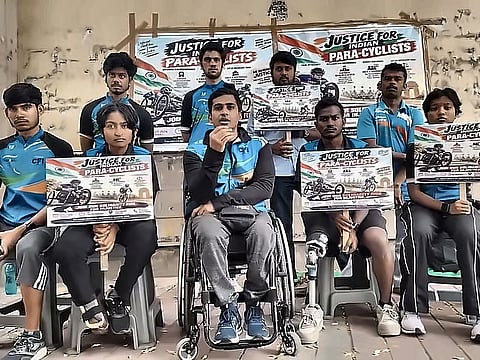
Hyderabad: India’s record medal haul at the 2026 Asian Para Games was a measure of how far its para-athletes have come. But for five para-cyclists, the weeks before the Games were marked by a different (and harrowing) contest: be allowed to compete as a part of the Indian contingent.
India won 114 medals in Aichi-Nagoya — 30 gold, 35 silver and 49 bronze to finish fourth overall, shedding renewed spotlight on how much para-sports have achieved in the country. Yet, the exclusion of five cyclists has raised eyebrows on the selection process and the support the para-athletes receive (or not!) in the run up to the selection.
For these five para-cyclists, the disappointment ran deeper than rejection. It was their efforts not being acknowledged (let alone appreciated) by those who decide India's representation at the paralympics.
One of the five pala-cyclist who did not make the cut is Prashant Sudarshan Arkal, ranked Asia's No.2 in men's hand cycling.
Prashanth said Indian para-cyclists competed internationally throughout 2025 to accumulate points for India under the relevant qualification system. He recalled competitions in Thailand, the World Championships in Beijing, and the track World Championships in Brazil, among others.
After all the efforts, the points accumulated between January and December 2025 secured four places for men and three for women at the Asian Para Games. He said the Cycling Federation of India (CFI) submitted the names in coordination with the Paralympic Committee of India (PCI).
“We got four main slots by accumulating 1,016 points for men, and for women, 456, and we got three slots. We were in the final camp, training for the Asian Para Games.”
He then said that, shortly before the Games, a government sanction order dated October 1 approved only one para-cyclist, Arshad Shaik, to be included in the Indian contingent.
Arkal, Pavan Kumar Kommoji, Sameer, Vishvaben Babubhai Vasani and Lisha Das challenged the decision. They argued that a selection committee had unanimously selected them in July and that unused quota places remained available. They also sought permission to compete at their own expense.
Pawan Kumar, another para-cyclist adds “We had qualified, but our names were not included in the final team. Almost everything had been completed. The Cycling Federation had approved the process, and the Paralympic Committee had also confirmed it. But when the matter reached the Ministry of Youth Affairs, our names were not included in the final list.”
The government maintained that the athletes did not meet the performance benchmarks in its September 2025 selection policy. Under the criteria considered by the court, athletes in events with six to 12 participating countries generally had to finish in the top four; where fewer than six countries participated, they had to finish in the top two.
Manish Rana, representing the Paralympic Committee of India (PCI), said "the selection decision was based on the athletes’ performances over the preceding year and the government’s prescribed benchmarks. The aim was to send a team with realistic medal prospects, rather than select athletes for exposure alone".
Rana acknowledged that Arkal’s performances had been discussed, but said he ultimately did not meet the selection requirements. He maintained that the decision was made jointly by the relevant sporting bodies and the Sports Ministry in accordance with government guidelines.
Arkal argues that the decision placed too much weight on results at the 2026 Asian Para-Cycling Championships in Saudi Arabia and did not adequately account for other provisions in the policy, including consideration of international rankings and recommendations from the relevant sports federation in special cases.
"They have not considered that these athletes went to 2025 competitions, earned the points, and based on the points they have earned the slot. There were multiple points in the sanctioned document. They have only considered this one point.”
He also refers to a competition in France in August 2026, where he says he finished ahead of a competitor who had placed third in Saudi Arabia.
Prashanth described the case of Vishwa, a female para-cyclist in the C3 classification, who despite winning silver at the 2026 Asian Championships, was not considered eligible under the rule, as there were only two participants.
“What they mentioned is that if there are fewer than six countries, you should finish second, which she did. But she wasn’t sent to the competition”.
He believes this was inconsistent with the rule.
"It was not her fault that four countries did not participate in the Asian Championship. The rules should be fair and appropriate for the athletes concerned.”
Manisha Rana justifies the decision saying "We did everything as per the government guidelines, whatever was permissible. We took into account what we had to, and we had to take those hard decisions."
Rana cited para-athlete Sundar Gurjar as another example of an accomplished athlete who, he said, had not been selected despite his past success. If that exception were made for one athlete, he said, others could make the same request; selectors needed a consistent cap on participation.
He also pushed back against the idea that an exception was an obvious solution. "With a contingent of more than 160 athletes, there could be many cases in which an athlete wanted special consideration. Where, would selectors draw the line?"
On the question of self-funded participation, Rana was unequivocal. A national contingent, he argued, could not allow athletes to pay their own way in after failing to secure official clearance.
"Asian Games is an elite level of sports, so that is no question at all. There has to be some directive and some cap on how and what participation can be allowed. If self-funding, then there would be 10,000 athletes who would be able to self-fund and want to go."
The High Court’s ruling aligned with the government’s position on self-funded entry. It held that the policy allowed only athletes cleared at government expense to form part of the contingent.
Rana did acknowledge a problem with timing. The final government lists, he said, arrived late for several sports, not just para-cycling. He said SAI would be better placed to explain the delay.
"The government list came in pretty late, not just for one sport, but for a lot of sports and only the Sports Authority can answer that."
The SAI however defends saying " PCI was supposed to send us the list by July or August, but the selection list reached it later than expected, around September. We could assess the ministerial criteria only after receiving the list, then announced in October." The SAI also establishes timelines for the benefit of athletes and federations, but if a federation does not meet them, SAI can only persuade or pressure it to submit the list.
This delay left the athletes with insufficient time to challenge their non-selection.
The dispute is about selection, but the road to selection costs money. Arkal said his handcycle cost around ₹17 lakh. He also described relying on personal funds and foundation support for training and international competition. Pavan Kumar has spoken of relying on NGOs like Aditya Mehta Foundation in assistance for expenses such as accommodation, food and training.
These are not incidental costs. International results can strengthen an athlete’s case for selection, but getting to competitions requires equipment, travel and sustained preparation. If athletes depend on personal resources or charitable support to build their records, access to those opportunities may not be equal.
Classification is another part of the para-sport system, although it was not the issue in the cyclists’ court case. It determines the sport class an athlete competes in, based on how an eligible impairment affects performance. In para-cycling, Arkal said, classification also affects the kind of cycle or handcycle an athlete uses. It is separate from the decision about who represents the country.
Rana’s case is that the selectors followed the prescribed rules and chose on merit. Arkal’s is that his results and the circumstances of his preparation were not adequately reflected in the final decision. The court has dismissed the challenge; it has not answered every question about how the process was communicated or how athletes can prepare for it.
India’s medal tally tells one story of para-sport. The cyclists’ experience points to another: the cost of reaching international competition, the criteria used to choose a team, and whether athletes understand those criteria before the final list arrives.