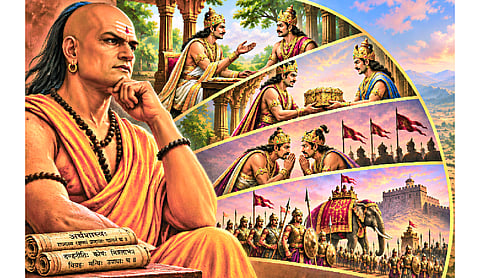

Kautilya’s Arthashastra (Adhikarana 2, Adhyaya 10) presents four expedients (upayas): Sama (conciliation), Dana (gifts/incentives), Bheda (dissension) and Danda (punishment or force) as effective instruments of statecraft. Dama is commonly a variant or mispronunciation of Dana.
The logical sequence is Sama-Dana-Bheda-Danda, running from least to most coercive, making military action the last resort rather than the first instinct.
Sama and Dana
Sama prioritises negotiation, reassurance, treaties and peaceful settlement, reducing the human and economic costs of conflict. Dana uses rewards, trade, aid or concessions to align an adversary’s interests with one’s own. Kautilya treats these as preferable first options because they preserve stability and resources.
Bheda and Danda
Bheda seeks to divide an opposing coalition or weaken an adversary’s cohesion through political differentiation; in modern security terms, it resembles exploiting cleavages while remaining within legal and ethical limits. Danda is the final resort, used when diplomacy and incentives fail.
A Prudent Policy
Ancient Indian thought codified a persuasion-before-force toolkit; an early, systematic security logic whose enduring value lies in sequencing: negotiate, reward, divide and only then strike.
The marvel also lies in escalation control: Bharat’s strategic tradition does not begin with war but offers a calibrated ladder from dialogue to deterrence. This makes the framework relevant to present-day diplomacy.