
Rice and Food Security
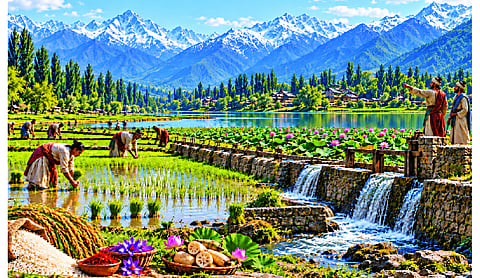
Kashmir's agrarian accomplishment rested less on a single crop than on managing water across a flood-prone valley. Archaeological reports date the rice remains at Semthan (an important archaeological site, now a village, in the Anantnag district) around 1500 BCE. Later, Kalhana's Rajatarangini, the most significant historical record of ancient Kashmir, credits King Avantivarman (855-883 CE) and his engineer Suyya with regulating rivers, improving canals and matching water supply to different soils. It describes how irrigation and flood control expanded cultivation and helped ease food scarcity. That intelligent blending of engineering and surplus makes rice central to Kashmir's history of food security.
Saffron and Distinctive Soil
Saffron (kesar) added a high-value crop to this agricultural landscape. Kashmir's well-drained Karewa soil and cool climate suit saffron cultivation. Kalhana counts it among Kashmir's special distinctions. Its origin is debated: one study suggests Central Asian settlers around the first century BCE.
Lotus and Wetland Food
Lotus stem (nadru) represents food drawn from Kashmir's lakes and wetlands, complementing field crops. Together, rice, saffron and wetland produce, supported by hydraulic engineering, exhibit diversified agriculture built for resilience.