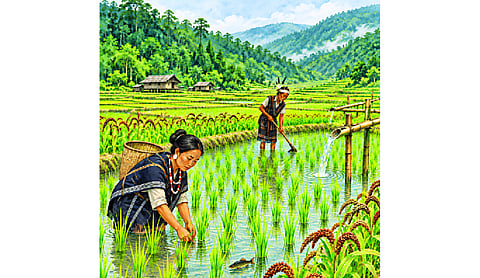

An Indian Community Grows Rice, Fish and Millet Together in the Same Fields!
In Arunachal Pradesh's picturesque Ziro Valley, the Apatani community has developed a remarkable farming system that produces three different foods from the same agricultural landscape--rice, fish and millet! The Apatanis are an indigenous community inhabiting the Ziro Valley in the Lower Subansiri district of Arunachal Pradesh. Their settlements are surrounded by forests, streams and cultivated fields. Agriculture has historically been central to their livelihood and social organisation.
In this traditional system, rice grows in water-filled paddy fields while fish are reared in the same water. Finger millet is cultivated on the raised earthen boundaries separating the plots, ensuring that even the field margins are put to productive use. Water from streams flowing down the surrounding forested hills is carefully channelled into the fields through an intricate irrigation network. Crop residues and organic wastes help replenish soil nutrients, reducing dependence on chemical fertilisers. The particularly interesting feature is the relationship between forests and agriculture. In the Apatani system, protecting the forested hills helps maintain the water supply for the fields below. Thus, forest conservation is not separate from agriculture--it is part of the farming system itself.
The Apatanis' agricultural knowledge reflects generations of adapting to the environment through efficient land use, water management and forest conservation. Recognising the significance of this living cultural landscape, India placed the Apatani cultural landscape on UNESCO's World Heritage Tentative List in 2014.