
- HOME
- INDIA
- WORLD
- BUSINESS
- STATES
- LAW & JUSTICE
- ENTERTAINMENT
- SPORTS
- VIEWPOINT
- LIFESTYLE
- TECH
Few concepts are as fundamental to our culture as the concept of dharma and karma. Our scriptures, at a basic level, have been prescriptive in the definition. But they have also attempted to resolve the conflict between the two. Swadharma emerges from this resolution. It can mean one’s duty, morality, righteousness, law, proper conduct, responsibility, religious obligation and even the principle that sustains the cosmos. Its meaning can change according to the individual, circumstance and context of discussion. Consequently, the Hindu tradition does not normally approach it by merely asking, “what rules must I obey?” but with more difficult question, “what I ought to do, given who I am, the responsibilities I carry, the circumstances in which I find myself, and the larger good that my actions must serve?”
This concept has seen an evolution that can be traced from the Taittiriya Upanishad (ethical foundation of swadharma), the Manusmriti (classified and codified duties), the Valmiki Ramayana (duty explained through exemplary lives), the Mahabharata (duties during conflict) and finally the Bhagwad Gita (duty as spiritual liberation). Taken together, they produce one of the most sophisticated bodies of reflection on personal responsibility. We explore swadharma through each of these scriptures.
One of the clearest and simplest early statements of swadharma occurs in the eleventh Anuvaak of the Taittiriya Upanishad as instructions given by a teacher to a student. Satyam Vada, Dharmam Chara, Swadhyatmayama Pramada: and Prajatantu Ma Vyavachhetsi. Speak the truth, never leave the path of dharma, never swerve from the teachings of the scriptures and do not break the cycle of procreation.
The Anuvaak goes on to say, Matri Devo Bhav, Pitri Devo Bhav, Acharya Devo Bhav, Atithi Devo Bhav. Honour the mother, father, teacher and guest as worthy of the highest reverence. This passage is remarkable because it does not separate spirituality from ordinary human relationships. Swadharma begins not in metaphysical speculation but in truthfulness, learning, gratitude and responsibility toward other people. The implication is important. Hindu ethics do not initially conceive the spiritual individual as isolated from society. The individual is born into webs of obligation towards others. Taittiriya Upanishad thus lays the basic ethical foundation of swadharma.
If Taittiriya Upanishad states ethical principles, Ramayana expands the scope where one duty comes in conflict with the other. Ramayana can almost be read as a long series of experiments in conflicting duties. Rama is simultaneously a son, a husband, a brother, a prince, a warrior, and eventually a king. Each identity generates obligations. So is Sita or Lakshmana or Ravana. All resolving situations of discharge of duty when multiple roles pull them in different directions. Each resolution leaves a profound lesson that swadharma is not simply doing whatever maximises one’s own legitimate entitlement. It could mean accepting a personal loss in order to protect a larger moral principle or choose social responsibility over responsibility towards family in order to legitimise authority. Ramayana thus demonstrates the complexity of role-based ethical foundation of swadharma where discharge of responsibility becomes a question of hierarchy and priority.
The Manusmriti approaches the concept of swadharma as an ordered structure of life. It seeks to classify duties according to the organisation of society and the stages of life. Shloka 6.87 says Brahmchari Grihastashracha Vanprastho Yatisthata, Ete Grihasthprabhava Shrachtwar Prithgashrama or the student, the householder, the hermit and the Renunciate - all these four distinct stages of life emanate from the Householder. The principle behind this scheme is sophisticated. Swadharma changes as life changes. What is appropriate for a student may not be appropriate for a householder. What is obligatory for a householder may eventually become an impediment for the renouncer. Manusmriti therefore prevents swadharma from becoming static. It distinguishes universal ethical principles from historically conditioned social regulations that are necessary for maintaining social order.
A more complex treatment of swadharma comes from the Mahabharata. The epic repeatedly undermines any confidence that moral life can be reduced to simple rules. Its deepest insight can be summarised in the expression: swadharma is subtle and difficult to discern because life situations often pitch one good principle against the other. The epic therefore makes moral judgment indispensable to the discharge of swadharma. The most detailed treatise on swadharma is the 12th book of Mahabharata, the Shanti Parva where Bhishma lying on the bed of arrows explains to Yudhishtra that swadharma is a synthesis of duties in the form of ethical conduct, justice, social responsibility and renunciation. He explains rajadharma, apaddharma, and mokshadharma. The Mahabharata understands swadharma as the preservation of a moral order under dynamic circumstances.
Finally, the Bhagavad Gita probably describes the most profound concept of swadharma - the philosophy of action. It begins with Arjuna’s dilemma of competing moral claims of a warrior requiring him fight his teachers, relatives, friends and elders. Krishna’s response produces a new doctrine of swadharma. Shloka 3.35 says shreyaan swadharmo vigunaah para-dharmaat swanushtithaat or it is better to perform one’s own dharma imperfectly than to perform someone else’s dharma perfectly.
Arjuna initially imagines renunciation as morally superior to fighting. Krishna rejects this simplistic opposition. Karmanyeva Adhikaraste ma faleshu kadachana ma karmfalheturbhu ma te sango astavkarmini (2.47) or you have the right to perform your duties but not entitled to the fruits; don’t be attached to the outcomes and never be inclined to inaction. Gita’s doctrine of nishkama karma or action without attachment to its fruits changes the moral centre of human conduct. Krishna goes further, sarva dharman parityajya mum eka? sharanam vraja aham tvam sarvapapebhyo mokshayisyami mashuchah (18.66) or abandon all material notions of duty, surrender to Me and I will free you from all sins. This links dharma, karma, detachment and ultimately moksha.
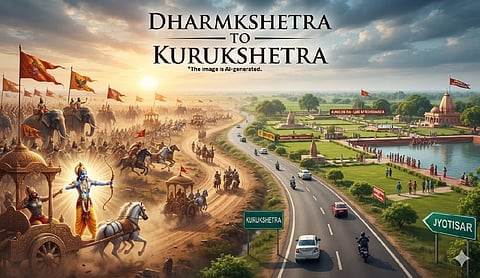
Swadharma, dharma plus karma, in Taittiriya Upanishad is an ethical orientation. In Ramayana it becomes fidelity to relationships and responsibility. In Manusmriti, it is structured social responsibility. In Mahabharata, it is moral discernment. Finally, in Bhagwad Gita it is responsibility transformed into spiritual discipline. This is our journey from dharmkshetra to kurukshetra.
For Bharat Ki Soch, the evolution of Swadharma offers a civilisational framework for addressing contemporary challenges by harmonising the individual onus of ethical conduct and collective wellbeing. The enduring wisdom of our scriptures can enable us to develop culturally rooted and contextually relevant approaches to governance, social responsibility and national development while critically engaging with present-day realities.
Manoj K Arora, Hony. Visiting Fellow, Bharat Ki Soch; former IRS Officer; Views presented are personal.