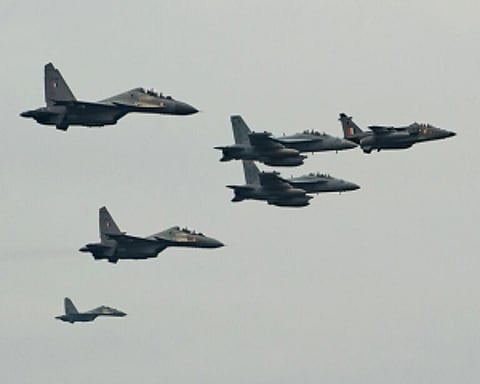

The inevitable kinetic response by India to the Pahalgam carnage was in its limited and selective description symbolically narrated by multi-faith women officers of Army and the Indian Air Force and Kashmiri Foreign Secretary Vikram Misri and dressed up appropriately as Operation Sindoor, the codeword chosen by Prime Minister Narendra Modi. It came yesterday morning, two weeks after the terrorist attack and was synchronized with mock drills for war damage limitation to the anticipated Pakistan counter strike the next day.
India’s retribution was progressively notched up from its earlier responses against terrorist attacks for Uri across Line of Control in 2016, and the unprecedented air strikes in Balakot, Pakistan in retaliation for Pulwama terrorist assault.
Yesterday, multiple strikes were carried out across both International Border and LoC inflicting enormous damage to Jaish and Lashkar terrorist infrastructure but according to Pakistan, it also destroyed two mosques close to targets and killed and wounded many civilians.
Like in 2019, India made clear that military strikes were in self defence, against cross border terrorism, not military targets; they were preventive, proportionate, non-escalatory and were accompanied by a warning that any Pakistani misadventure would be responded to in kind, alluding to Pakistan military’s inevitable response similar to the one in 2019.
India had then announced after the Balakot strikes that its military operations were concluded. What was left unclear from the Indian briefing was the kind of weapons used in the multiple attacks. Unlike in 2019, there was clear evidence of the strikes and the damage caused to the targets.
Pakistan’s National Security Council, the equivalent of India’s Cabinet Committee on Security, condemned the attacks and authorised the military to give a corresponding response. But Rawalpindi will be faced with the dilemma of target selection. It could hit hydropower projects after India weaponised the Indus Water Treaty or go for military targets in Jammu and Kashmir in sync with symbolic air and missile strikes in north India or elsewhere .
Pakistan’s air defences have proved ineffective against Indian missiles and drones as none was reported shot down. This reflected holes in Pakistan aerial defence network. India’s layered air defence, on the other hand, is led by at least one battery of S400 missiles considered one of the most potent systems acquired from Russia. It will act as the key deterrent to any Pakistani counter air/missile strikes. The timing of Pakistani retaliation will likely keep India guessing; it is unlikely to be an immediate knee-jerk response like in 2019 when a dogfight had led to the capture of Wing Commander Abhinandan.
Other accidents on the Indian side stole the shine from the bold air attacks, which Pakistan claimed had caused no damage. The next phase of battle should be expected soon preferably laced with the hope that escalation will end there; provided like in 2019, India does not respond. US should be expected to step in. This time, the risk of escalation is much greater and its level can go higher. Fingers crossed.
(The writer, a retired Major General, was Commander, IPKF South, Sri Lanka, and founder member of the Defence Planning Staff, currently the Integrated Defence Staff)