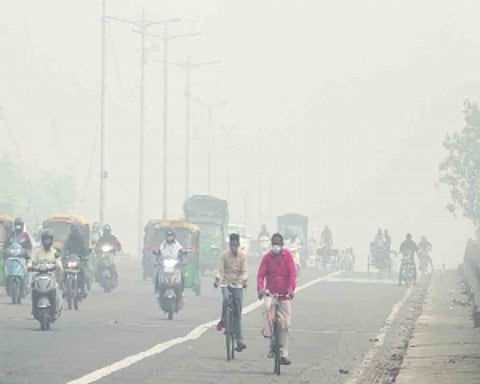

Reduce vehicle usage by 30%, Delhi offices told
As thick layers of smog affected visibility and revived the yearly menace of winter-time pollution in Delhi on Friday, the Central Pollution Control Board (CPCB) advised people to avoid going outdoors and asked Government and private offices to reduce vehicle usage by 30 per cent.
In an order, the CPCB said that at a review meeting held earlier in the day, it was observed that meteorological conditions will be highly unfavourable for dispersion of pollutants till November 18 in view of low winds with calm conditions during the night.
“Government and private offices and other establishments are advised to reduce vehicle usage by at least 30 per cent (by working from home, car-pooling, optimising field activities, etc). People are advised to limit outdoor activities,” the CPCB said.
It also said that the implementing agencies, at appropriate level, must closely monitor actions taken and submit daily report to pollution control boards and committees concerned which will review and further submit reports to the Commission of Air Quality Management (CAQM) and CPCB.
“Concerned agencies must be in complete readiness for implementation of measures under ‘emergency’ category as per GRAP (Graded Response Action Plan),” it said.
Meanwhile, the air quality worsened and remained in a severe category as the overall air quality index (AQI) settled at 499 micrograms per cubic. According to SAFAR, there will be no respite from noxious air quality on Saturday and Sunday due to an increase in farm fire counts and an increase in transport level wind speed during the night.
Elaborating more, System of Air Quality and Weather Forecasting And Research (SAFAR), a unit of the Ministry of Earth Sciences (MoES), said the effective fire count increased to 4056 while the share of crop residue burning was 35 per cent in Particulate Matter 2.5.
As per the National Ambient Air Quality Index (NAAQI), the values of PM 10 and 2.5 were recorded at 541 and 349.
These values recorded many folds higher than prescribed standards set by World Health Organisation (WHO) and Indian Meteorological Department (IMD).
“A drop in minimum temperature is likely for the next two days resulting in air quality to be in severe to the upper end of the very poor category. However, increase in local surface wind speed helps disperse pollutants,” the pollution monitoring agency said.
Several other cities in the National Capital Region (NCR) such as Noida, Gurugram, Faridabad, and Ghaziabad and towns in north India, including Bhiwadi, Fatehabad, Hisar, and Hapur, also faced severe level air pollution in the morning.
Air pollution of severe levels affects healthy people and seriously impacts those with existing diseases, said the CPCB.
The air quality of the national Capital has been severe for five out of seven days post-Deepawali. The air quality index (AQI) of Delhi is likely to stay in the very poor to severe range on November 12 and November 13, the authorities said.