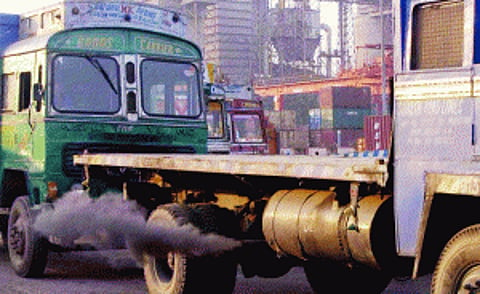

Beginning November 1, trucks, light goods vehicles and heavy containers passing through Delhi will have to pay `700 or `1,300 (depending on the category of vehicle) as the Supreme Court on Monday asked the Delhi Government to collect the amount as a pollution tax on an experimental basis till February 29. However, ambulances, passenger buses and vans and vehicles carrying essential commodities, food stuffs and oil tankers have been exempted from the levy.
With an aim of reducing pollution level in Delhi’s air, the Supreme Court on Monday approved the joint proposal by the Centre, the Delhi Government and senior advocate Harish Salve. The Bench of Chief Justice Hl Dattu, Justices Arun Mishra and Adarsh Goel said, “The Government of NCT of Delhi may issue an appropriate notification to levy the aforesaid charge forthwith which will be operative for a period of four months starting from November 1, 2015 to February 29, 2016 on an experimental basis.” The SC will review the mechanism in the third week of February, to incorporate changes or modifications required in the levy of Environment Compensation Charge (ECC).
To ensure the collection of ECC does not result in snarls at entry points to Delhi, the SC ordered neighbouring States of UP, Haryana and Rajasthan to place huge billboards at the exit roads from where commercial traffic can take an alternate route avoiding Delhi. The Delhi Government agreed to have radio frequency identification for collection of ECC on nine entry points by November-end and cover all entry points by January 31, 2016. In addition, CCTVs will monitor toll collection.
Senior advocate Harish Salve, who is assisting the Supreme Court as amicus curiae in environmental matters, had mooted the idea of imposing heavy tax on commercial carriers to dissuade them from passing via Delhi. Following which, the SC asked the Centre and the Delhi Government to jointly come with a proposal.
As a result of deliberations between the Centre and the Delhi Government, it was decided to charge Rs 700 from light goods vehicles and two-axle trucks and Rs 1,300 from 3-axle and 4-axle trucks. This tax would be collected in addition to the tax already collected by MCD at all the 127 entry points. The receipt of ECC will be submitted to the Delhi Government every week and this money will go towards augmenting public transport and improving roads.
Salve had told the court that Delhi's air was deteriorating drastically due to the heavy load of commercial traffic passing through Delhi. He pointed out that these vehicles are not Delhi-bound but choose to cross the national Capital to avoid heavy toll tax on alternative route of NH 71 and NH 71A connecting Rewari to Panipat.
A study conducted by Centre for Science and Environment showed that nearly 40-60 per cent heavy trucks entering the Capital are not Delhi-bound. Their presence contributes to 30 per cent of particulate matter load and 22 per cent of nitrogen oxide found in Delhi air, Salve quoted from the CSE study.
The court admitted the real and present danger as even the CJI shared the experience of his grandchildren having to wear mask to school resembling a Ninja.