
Can Muslims enjoy the benefits of minority community in Jammu & Kashmir despite being in majority thereIJ On the controversial issue, the State Government’s response is a resounding ‘yes’ while the Centre has chosen to remain silent despite being slapped a fine of Rs30,000 by the Supreme Court on Monday.
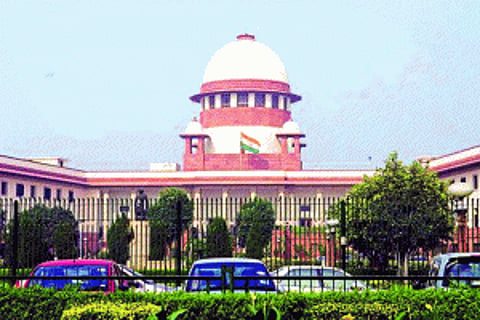
Not happy with the manner in which an important Constitutional question was getting dragged, the apex Bench of Chief Justice JS Khehar and Justice NV Ramana decided to give one last opportunity to the Centre to file its response. The court was hearing a PIl filed by a Jammu-based lawyer Ankur Sharma. On the last hearing, the SC had imposed a fine of Rs15,000 on the Centre for not submitting its response.
The Centre’s silence contrasted the upfront response of the State Government, which said that singling out benefits doled out to Muslims in the State was not fair on part of the petitioner as similar situation exists in Punjab (with Sikhs in majority), Nagaland, Meghalaya, Mizoram, Arunachal Pradesh, and lakshadweep. “Any decision passed by the court must be holistically and uniformly be made applicable to all the States and UTs,” said the State in its reply.
Since Hindus are a minority in J&K, the petitioner had objected to Muslims cornering benefits under national minority schemes available in the State. The petition prayed for a direction to National Minorities Commission to determine afresh the “religious and linguistic” minority communities in the State. It requested for an independent commission of experts to identify minorities in the State. Till such time, it wanted to stop all benefits flowing to Muslims under state minority schemes.
Explaining the law on this subject, the State cited Section 2(c) of the National Minority Commission Act 1992 under which minorities are to be notified. Although the Act does not extend to Jammu & Kashmir, yet the State Government simply acts as a “channelising agency” to implement all Centrally-Sponsored Schemes for minorities.
On the prayer that the State should have its own State Minority Commission, the affidavit said, “It is for the State legislature to consider in its wisdom as to which laws are required to be made considering the circumstances prevailing in a State.” The State blamed the petitioner for approaching the court with “unclean hands” and a “hidden agenda” as the petition made no mention of States having a similar problem where an identified minority community is a majority.
Interestingly, the affidavit quoted Clause 7 of the Prime Minister’s 15-point programme which talked of welfare programmes targeted for minority communities such as Muslims, Christians, Sikhs, Buddhists and Parsis. This clause further stated that where one of the above minority communities was in majority. “The earmarking of physical/financial targets under different schemes” will go to other notified minorities in the State. But since this is not part of any law, it cannot be enforced. And it neither serves the cause of the petitioner since Hindus who are a minority in J&K cannot be entitled to minority benefits till they are so identified in the State.