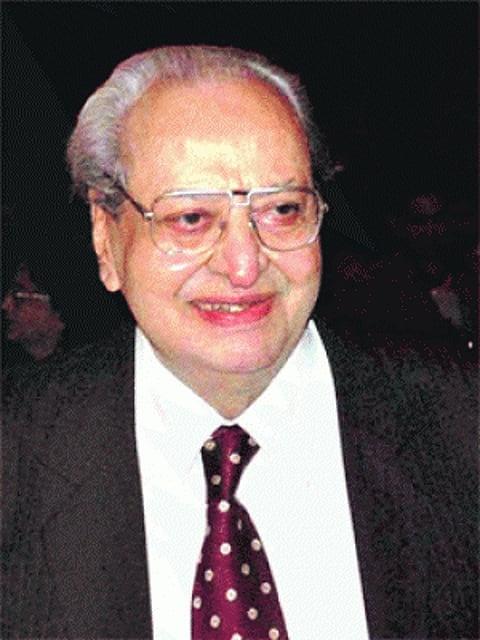

And above all Pran.” That’s how the credits rolled for the man who breathed his last in the 100th year of Indian cinema and the last Mohican who fought valiantly to score a living century himself. Yes, the villain, the comedian and the character actor aced all categories to become a versatile performer, one that merited a special mention despite the presence of Hindi film’s superstars. He was above all else.
The home page of his website is testimony to his cross-generational appeal — the gentleman-smart-devil inside coolness, the smooth operator, the funnyman with an impish plan, the piercing eye with crooked intention, the smoking pipe curling up many mischievous moves, the crafty twist of the hat and a guttural throw of words that made evil almost visceral and relatable. Yet, as that villain aged, it seemed he was tired of all the deviousness and wanted to make all his wrongs right. So there were the generous Khan chachas and the many lordly, indulgent grandfathers who had the timber to last out life’s ebbs and tides and the authority to hold the moral fibre of a story. He was believable in his transition and the greyness of a modern, social context. “I am 20-years old and a great fan of yours. I have been watching your movies since I started watching movies. I have immense respect for all artists of golden age especially you. The charm and magic you bring in movies can’t be expressed,” wrote a young fan on his home page last year.
Pran cherished the new generation, posting all pictures of fan encounters regularly till he was bed-ridden. He had even documented all his interviews on his website. Some of them had punchy answers only he could give. “What do you hate mostIJ Bad acting and poverty,” he told a publication. In that same interview, he said how he found it difficult to lip sync songs with Noorjehan in Khandaan in 1942. Heroes were uni-dimensional, villains with their complexity added layers to the template of the hero, he had said. His best director, though he credited Raj Kapoor, was Dilip Kumar, who, as unofficial director of Dil Diya Dard liya, extracted the best performance out of him.
Appearing in over 350 films, his roles in the films like Madhumati (1958), Jis Desh Men Ganga Behti Hai (1960), Upkar (1967), Shaheed (1965), Aansoo Ban Gaye Phool (1969), Johny Mera Naam (1970), Victoria No 203 (1972), Be-Imaan (1972), Zanjeer (1973), Don (1978) and Duniya (1984) are considered his career best.
Pran was born on February 12, 1920 at Ballimaran, Old Delhi, into a wealthy Punjabi family. His father, Kewal Krishan Sikand, was a civil engineer and a civil contractor, the reason he seemed to the manner born. He was good in mathematics, an ability that helped him graph his career path later. The first call was a slight miscalculation though. He believed he would make a great photographer and joined A Das & Co in Delhi as an apprentice. This job took him first to Shimla, where he played the role of Sita at a local Ramlila. The role of Rama was played by Madan Puri, his first brush with an actor.
He continued his travels till a chance meeting with the writer, Wali Mohammad Wali, at a shop in Hira Mandi, lahore, resulted in his first role in a Punjabi film Yamla Jat (1940). Directed by Moti B Gidwani, the film featured Noor Jehan and Durga Khote. The photographer realised that he was a photogenic subject and could alter frames by appearing before the lens. This was followed by small roles in the film Chaudhary and Khajanchi, both of 1941. Pancholi cast him again in Khandaan (1942), which was the first Hindi film in which Pran became a romantic hero, opposite Noor Jehan.
Pran had acted in 22 films from 1942–46 in lahore till the Partition brought him to Bombay, the natural choice to explore his talent which he had begun sharpening with zest. Though films didn’t come his way for months together, he kept looking for opportunities of acting along with other jobs. He started working in Delmar Hotel, Marine Drive and eight months later, in 1948, he got a chance to start all over again. With the help of writer Saadat Hasan Manto and actor Shyam, he got a role in the Bombay Talkies’ film, Ziddi which had Dev Anand and Kamini Kaushal as leads and was directed by Shaheed latif.
By 1950 he got established gradually as a premier villain in Hindi cinema. Be it Azaad (1955), Devdas (1955), Madhumati (1958), Dil Diya Dard liya (1966), Ram Aur Shyam (1967) and Aadmi (1968) or films with Dev Anand like Ziddi (1948), Munimji (1955), Amar Deep (1958), Jab Pyar Kisi Se Hota Hai (1961) and Raj Kapoor in Aah (1953), Chori Chori (1956), Jagte Raho (1956), Chhalia (1960), Jis Desh Men Ganga Behti Hai (1960), Dil Hi Toh Hai (1963), he calibrated himself as the perfect counterfoil.
Pran proved his versatility in the 1950s as the swashbuckling pirate in Sindbad the Sailor (1952) and Daughter of Sindbad (1958) and in action-packed thrillers like Azad (1955); historicals such as Aan (1952) and Raj Tilak (1958); social themes such as Baradari (1955) and light romances like Munimji (1955) and Asha (1957). Subsequently, even though he was in his forties, his demand in the film market never went down and he was given pivotal supporting roles. So while the heroes waned in charisma, be it Dilip Kumar, Raj Kapoor, Shammi, Kapoor, Dev Anand and later Rajesh Khanna and Amitabh Bachchan, he kept himself relevant in business.
Always challenging his own abilities, he even did comedies with Kishore Kumar and Mehmood. His memorable collaborations with Mehmood include Sadhu Aur Shaitaan (1968), lakhon Me Ek (1971) and with Kishore Kumar include Chham Chhama Chham (1952), Asha, Bewaqoof (1960), Half Ticket (1962) and Man-Mauji (1962).
But it was as Malang Chacha in Manoj Kumar’s Upkar (1967) and the soulful lip syncing of Kasme Waade Pyaar Wafaa that showed his gravitas and intensity. Gone was the shrewd alertness of the eyes, in came an all-encompassing embrace, out went the black, in came the brown eyes.
Then there were the real life friendships. He was very close to Ashok Kumar and they did 27 films together from 1951-1987, their Do Bechare from Victoria 203 still making for an instant recall.
There was a time when he was paid more than heroes, even an Amitabh Bachchan. He was paid between Rs5-20 lakh between 1970 and 1982. And yet he was egoless and in fact recommended newcomer Amitabh Bachchan to Prakash Mehra for the character of Vijay in Zanjeer, which was earlier offered to Dev Anand and Dharmendra but was rejected by them. He acted with Amitabh in 14 films. The men who made Amitabh the “Big B,” Mehra and Manmohan Desai, could not imagine a storyline without the “Pillar P.”
In the late 1990s, Pran started rejecting film offers citing age-related problems. But when Bachchan was going through a bad patch in his career, he stepped in to help him out in his home productions, Tere Mere Sapne (1996) and Mrityudata (1997), even though his legs had given in and he could not stand for long.
He did try to stand to receive his Dada Saheb Phalke award, too late in coming for a versatile role player, who in the truest sense tested himself in every genre and was perhaps the most prolific among the glittering stars of our film industry. For somebody who changed his roles, literally (he liked experimenting with his looks) and metaphorically, he was a simple, unassuming man. Yet he connected with his warmth, pulling at our heartstrings. Hope the industry was as generous.
eom