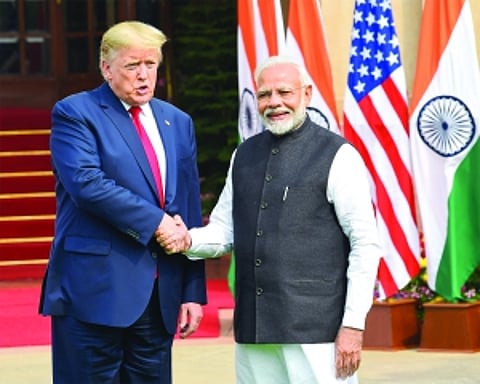

US President Donald Trump announced Wednesday that the United States will impose a 25 per cent tariff on all goods imported from India beginning August 1, marking a significant escalation in trade tensions even as both countries continue negotiations on a long-anticipated bilateral trade agreement.
“Remember, while India is our friend, we have, over the years, done relatively little business with them because their tariffs are far too high — among the highest in the world — and they have the most strenuous and obnoxious non-monetary trade barriers of any country,” Trump said in a social media post.
In the same message, Trump criticised India for its continued purchases of Russian crude oil and military equipment, stating that such actions undermine international efforts to halt Russia’s ongoing aggression in Ukraine. “All things not good,” Trump added. “There has to be a penalty.”
Though he did not specify what additional penalties India may face beyond the new tariff, the announcement has sparked concern across economic and diplomatic circles on both sides of the Atlantic.
According to data from the Office of the US Trade Representative (USTR), total goods trade between the US and India amounted to $129.2 billion in 2024, with American exports at $41.8 billion and imports from India at $87.4 billion — leaving a trade deficit of $45.7 billion. India, which counts the US as its largest trading partner, could face sharp economic consequences from the tariff. Indian exports to the US play a critical role in generating foreign exchange, and analysts warn that the additional duties could deepen India’s current account deficit and put pressure on the rupee. The timing of the tariff decision comes as a setback to ongoing trade negotiations between the two nations. A sixth round of talks is expected in India next month, and both sides had aimed to finalise the first phase of a deal by fall 2025.
The US has demanded broader market access and near-zero tariffs for its exports, particularly in industrial and agricultural goods. India has pushed back on liberalising sectors such as dairy and agriculture, citing the need to protect rural livelihoods.
Despite the current friction, both countries have reaffirmed their goal of doubling bilateral trade to $500 billion by 2030 — a target now thrown into uncertainty.
Beyond trade, India and the US have made strides in defense cooperation, with Prime Minister Narendra Modi visiting Washington in February for talks that emphasised strategic and military collaboration. India is a key member of the Quad — a four-nation alliance with the US, Japan and Australia — aimed at countering China’s regional influence. While India has long relied on Russian military hardware, recent years have seen increased procurement of American defense systems, including jets, helicopters, and missiles. Both sides are expected to sign a 10-year defense framework later this year.
The Federation of Indian Chambers of Commerce and Industry (FICCI), one of India’s oldest and largest business organisations, issued a statement in response to the US tariff on Indian exports. FICCI President Harsha Vardhan Agarwal expressed disappointment over the move, stating: “FICCI is disappointed by the decision taken by the US to levy a 25 per cent tariff on exports from India and impose secondary sanctions. While this move is unfortunate and will have a clear bearing on our exports, we hope that the imposition of higher tariffs will be a short-term phenomenon and that a permanent trade deal between the two sides will be finalised soon.”
Indian officials have so far responded cautiously, but behind closed doors, trade and finance ministries are reportedly assessing the potential damage and devising countermeasures.
“We’ll need to find ways to soften the blow,” one senior Indian trade official said, requesting anonymity.
“Retaliatory tariffs are not off the table, but our priority is to keep the dialogue going.”
A US trade delegation is expected to land in New Delhi in late August. Whether diplomacy can undo the damage done by the tariff remains uncertain.
There is no immediate reaction from India on Trump’s announcement.
Sources indicate that a US delegation is set to visit India next month for the next round of negotiations on the proposed bilateral trade agreement. The fifth round of talks concluded last week in Washington, D.C., with India’s chief negotiator and Special Secretary in the Department of Commerce, Rajesh Agrawal, and Brendan Lynch, Assistant US Trade Representative for South and Central Asia, leading the discussions.