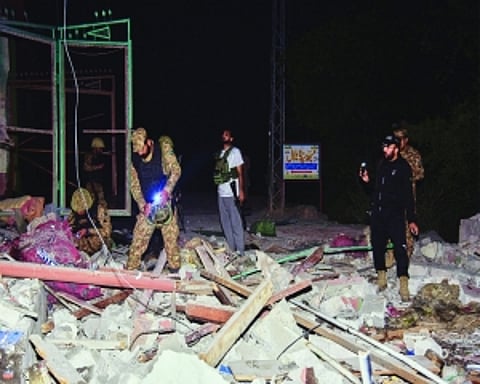

India strikes to deter further attacks
India on Wednesday morning carried out multiple military strikes codenamed ‘Operation Sindoor’ in Pakistan and Pakistan-occupied Kashmir (PoK) against terrorist infrastructure, killing more than 70. The retaliatory action came 15 days after 26 innocents were killed in a dastardly terrorist incident at Pahalgam.
Prime Minister Narendra Modi monitored the action throughout the early morning when missiles were launched against the designated targets at nine locations in Pakistan and PoK. The action commenced at 1.05 am and ended at 1.30 am. However, the punitive strikes avoided civilian casualties and Pakistani military installations. The PM also gave the codename ‘Operation Sindoor.’
Giving deails of the military action, Foreign Secretary Vikram Misri said Indian military carried out a “measured, non-escalatory, proportionate, and responsible” strike to dismantle terrorist infrastructure in Pakistan to “deter and to pre-empt” any further terrorist strikes.
Addressing a packed press conference, Misri said it was deemed essential that the perpetrators and planners of the April 22 attack be brought to justice as there was “no demonstrable” step from Islamabad to take action against the terror infrastructure on its territory or on territory under its control.
The briefing by Misri began with a video of several terror attacks including the 2001 Parliament attack, the 2008 Mumbai strikes and the 2019 Pulwama suicide bombing, which were carried out by Pakistan-based terror groups.
“Our intelligence monitoring of Pakistan-based terrorist modules indicated that further attacks against India were impending,” he said at the briefing, which was also addressed by Colonel Sofia Qureshi and Wing Commander Vyomika Singh. The foreign secretary’s comments came hours after India struck nine terror camps in Pakistan and Pakistan-Occupied-Kashmir with missiles and drones under an operation christened ‘Operation Sindoor’. Misri said there was a compulsion both to “deter and to pre-empt”. “Earlier this morning as you would be aware India exercised its right to respond and pre-empt as well as deter more such cross-border attacks,” he said.
“These actions were measured, non-escalatory, proportionate, and responsible. They focused on dismantling the terrorist infrastructure and disabling terrorists likely to be sent across to India,” Misri said.
The foreign secretary said despite a fortnight having passed since the Pahalgam attacks, there has been “no demonstrable step” from Pakistan to take action against the terrorist infrastructure on its territory or on territory under its control.
On the Pahalgam attack, Misri said Pakistani and Pakistan-trained terrorists belonging to the Lashkar-e-Taiba(LeT) carried out the savage strike on Indian tourists and murdered 26 people. It was the largest number of civilian casualties in a terrorist attack in India since the November 26, 2008 Mumbai terror attacks.
“The attack in Pahalgam was marked by extreme barbarity, with the victims mostly killed with headshots from close range and in front of their families,” he said.
“Family members were deliberately traumatised through the manner of the killing, accompanied by the exhortation that they should take back the message,” Misri said.
The foreign secretary said the Pahalgam attack was “clearly driven by the objective of undermining the normalcy returning” to Jammu and Kashmir.
“In particular, it was designed to impact the mainstay of the economy, tourism, with a record 23 million tourists visiting the valley last year,” he said.
“The calculation, presumably, was that harming growth and development in the Union Territory would help keep it backward and create fertile ground for continued cross-border terrorism from Pakistan,” he said.
Misri noted that the manner of the attack was also driven by an “objective of provoking communal discord”, both in Jammu and Kashmir and the rest of the nation. “It is to the credit of the government and the people of India that these designs were foiled,” he said.
Citing cross-border linkages to the attack, he pointed towards a so called group calling itself “The Resistance Front” (TRF) claimed responsibility for the attack. “This group is a front for the UN-proscribed Pakistani terrorist group, Lashkar-e-Taiba,” he said.
“It is notable that India had given inputs about the TRF in the half-yearly report to the monitoring team of the UN’s 1267 Sanctions Committee in May and November 2024, bringing out its role as a cover for Pakistan-based terrorist groups,” he added.
Misri said “identification of the attackers based on eyewitness accounts, as well as other information available to law enforcement agencies, has also progressed.” “Our intelligence has developed an accurate picture of the planners and backers of this team,” he added.
Prime Minister Narendra Modi’s three-nation tour to Europe has been called off in view of escalating tensions between India and Pakistan. Modi was scheduled to travel to Croatia, Norway and The Netherlands from May 13 to 17.
As regards Operation Sindoor, it was learnt missiles and drones were used to take out the terrorist camps and buildings in an effort to avoid collateral damage and retain element of surprise.
The Indian military carried out precision strikes using niche technology weapons with careful selection of warheads that ensured no collateral damage, said Wing Commander Vyomika Singh, one of the two women officers who briefed the media on Operation Sindoor. The point of impact in each of the target was a specific building or a group of buildings, she said.
It was learnt weapons deployed included Scalp deep-strike cruise missiles that allow Rafale fighter pilots to attack ground targets from standoff ranges, the Hammer smart weapon system, guided bomb kits and M777 howitzers firing Excalibur munition. Loitering munitions were also used to strike the targets, officials aware of the matter said.
The target selection was done with due diligence, said Colonel Sofia Qureshi, the other woman officer who shared granular details of Operation Sindoor with the media.
“The selection of targets for Operation Sindoor was based on credible intelligence inputs and role of these facilities in perpetrating terror activities. The locations were selected to avoid damage to civilian installations and loss of civilian lives,” she said.
Defence Minister Rajnath Singh said the targets set under Operation Sindoor were destroyed with precision as per plan.
“We only killed those who killed our innocents,” Rajnath Singh said at the inauguration of Border Roads Organisation’s 50 infrastructure projects across six states and two Union territories.
Modi later met President Droupadi Murmu and briefed her on Indian armed forces’ precision strikes. The prime minister chaired a meeting of the Union Cabinet, hours after ‘Operation Sindoor.’
Soon after Defence Minister Rajnath Singh informed the Cabinet about Operation Sindoor, the entire Cabinet hailed the action and the prime minister’s leadership with thumping of desks.
National Security Advisor(NSA)Ajit Doval spoke to US Secretary of State Marco Rubio and his counterparts in several countries including Saudi Arabia and the United Arab Emirates.