
- HOME
- INDIA
- WORLD
- BUSINESS
- STATES
- LAW & JUSTICE
- ENTERTAINMENT
- SPORTS
- VIEWPOINT
- LIFESTYLE
- TECH
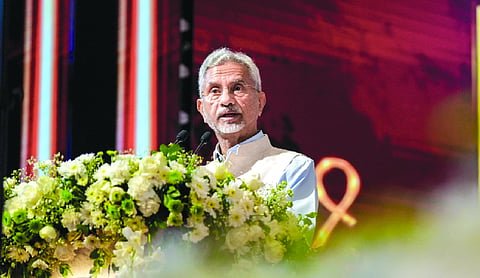
Union Minister for External Affairs S Jaishankar on Sunday said terrorism should not be used as an “instrument of Statecraft”, cautioning that the scourge continues as some nations prioritise political calculations despite the lessons of history.
“Terrorism is another deadly threat to peace. Its usage as an instrument of Statecraft is simply unacceptable. It can never be justified. It can never be rationalised. Yet it continues because not all States truly show zero tolerance,” he said.
“Despite history, holding so many lessons, some still allow political calculations to take precedence,” he added in the Capital on Sunday, without naming any country.
Jaishankar also said the United Nations (UN) must show leadership and “not be a spectator” to global crises, even as he urged the world body to recognise its shortcomings and limitations and seek improvement. In his address at the Chinmaya Amrit Mahotsav Global Sammelan on UN Day, he also asserted that the case for “reformed multilateralism” grows stronger by the day.
The remarks came days after US Secretary of State Marco Rubio defended Washington’s closer ties with Pakistan during his recent visit to India, arguing that engagement with Islamabad could give Washington greater influence over its decisions, including on terrorism.
“I think it allows us to have, hopefully, more influence over the decisions they make on a variety of topics,” Rubio said, adding that “no country in the world does more to go after terrorism than the United States”.
The minister also underscored the need to safeguard peace amid ongoing global conflicts, warning that wars in one region could threaten stability worldwide. Referring to the conflicts in Ukraine and West Asia, he said India echoed the global sentiment that dialogue and diplomacy remained the only solutions.
On the role of the UN, Jaishankar made his observations in the presence of UN Resident Coordinator in India, Stefan Priesner, who also shared the dais with him.
“We know we live in an imperfect world. But we all continuously strive towards greater perfection,” Jaishankar said.
As far as the UN is concerned, that means it needs to recognise “its shortcomings and limitations” and seek “improvement”, the minister added.
“The case for reformed multilateralism gets stronger by the day. Large parts of the world cannot be left out of decision-making. The UN must show leadership, not be a spectator to global crisis,” Jaishankar said.
He cited the two major conflicts in the world, in Ukraine and in West Asia, and said societies, economies and people far away who have little say in the matter are actually “paying the cost”.
“We cannot remain helpless spectators. India expresses global sentiment when we urge that dialogue and diplomacy are the only solution,” Jaishankar said.
The external affairs minister underlined that progress and prosperity are the flip side of conflict and violence, and equally indivisible.
“The world cannot advance half prosperous and half denied. In an era of intricate supply chains, of globalised markets, and of common resources, this is simply a prescription for continuous instability,” he cautioned.
Jaishankar reiterated that the Global South today faces a ‘4F’ crisis: finance, fuel, food and fertiliser, and said the Global North must realise it has “equal stakes” in finding solutions.
“The international economy must be urgently derisked and nations provided with more diversified options. Market distortions through constriction and chokepoints only add to suffering. A genuine dialogue in this regard is overdue,” the minister said.
Jaishankar also emphasised that people have long argued between those who stress competitiveness and those who see virtue in cooperation.
“These may be individual or even societal predicaments, but on the global stage, they translate into how nations behave with one another,” he said.