
The Supreme Court on Thursday ordered stark warning labels on packaged foods high in sugar, salt or fat, with a separate hexagon flagging each nutrient, rejecting a watered-down version of the scheme as something that would “undermine the very objective” of the exercise.
Each nutrient must get “a separate hexagon”, carrying the words “High Fat”, “High Sugar” or “High Salt” with a matching pictogram, “rather than a single combined hexagon”, the court said, asking the rules to come into force within a four-month timeline proposed by the food regulator. Companies will then get a 365-day transition period.
In a 131-page judgment, a bench of Justices JB Pardiwala and K Vinod Chandran directed the Food Safety and Standards Authority of India (FSSAI) to fix design and threshold flaws in its draft warning-label scheme. It also told the regulator to hold to its own timeline for bringing the rules into force.
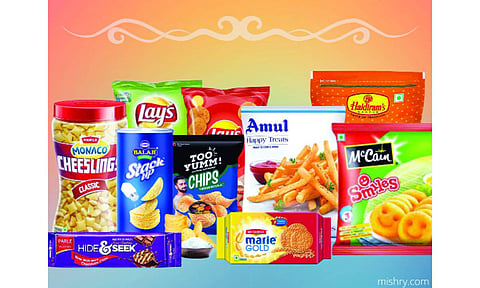
The ruling will impact everything from chips and biscuits to fizzy drinks.
“A consumer in India is entitled to no less protection, and no less information, than a consumer in the United States or the United Kingdom,” the court said, calling reports of differing practices by global companies “deeply troubling” if true. It named no company and urged multinationals to adopt uniform standards across countries.
The FSSAI had proposed a single red hexagon carrying the words “High Sugar”, “High Saturated Fat” and “High Salt”.
Sugar, salt, fat: SC mandates separate warning labels
The court said that would not work. It ordered a separate hexagon for each nutrient, each with its own pictogram and the words “High Fat”, “High Sugar” or “High Salt”. It said the design should let a shopper see at a glance that a product is high in all three, without parsing text.
Each hexagon must take up at least 4 per cent and up to 5 per cent of the front panel, in line with practice in countries with similar labels. The font must be “prominent, conspicuous and readily legible”.
Pardiwala, who wrote the judgment for the bench, said a words-only label “creates two classes of consumers — those who can use the information and those who cannot”. The label, he added, “must not be the exclusive reserve of the educated or the affluent”.
“Every meal is a quiet wager with one’s own body, and a wager is fair only when the player can see the odds,” he wrote in the opening paragraph. “The label is the only witness at the point of sale.”
The sharpest rebuke was reserved for how the regulator proposed to decide which products get a label.
The FSSAI wanted to trigger warnings on “added” sugar and “added fat”. The court said that, in a finished product, a laboratory cannot tell added sugar from the natural kind, so the rule could not be enforced. Makers could also escape the label by sweetening with fruit concentrate, it said.
“Added fat”, it noted, “does not exist anywhere in the world” as a label metric. The court said the regulator had ignored its own earlier consensus on total sugars and saturated fat, and ordered it to go back to them.
It also warned against setting thresholds too low. A study cited in the judgment found that 94.1 per cent of 44,109 packaged-food records would trip at least one warning under the proposed values. That, the court said, would breed “label fatigue”.
The regulator must now redo the evidence thresholds and tighten them over time.
The case began as a petition by the non-profit 3S and Our Health Society, which wanted warning labels instead of the star-rating system the FSSAI floated in 2022. That draft drew more than 14,000 comments. Consumers and health groups largely backed warnings. Many food businesses wanted a voluntary regime or none at all, citing livelihoods.
The All India Consumer Products Distributors Federation (AICPDF), which says it represents more than 400,000 FMCG distributors and 13 million kirana retailers, called the order “a significant step towards ensuring a scientifically balanced and practical” framework. It said its concern has always been the “disproportionate impact” of aggressive labelling rules on small domestic manufacturers.
“Consumer protection must not become a tool that disadvantages Indian MSMEs and strengthens multinational dominance,” national president Dhairyashil H Patil said in a statement.
The bench directed the FSSAI to revisit and reformulate the threshold levels for each nutrient of concern. It said that in fixing threshold levels, the FSSAI should ensure, based on evidence, that they are neither too low nor too high.
It said as regards the transition period, the FSSAI should take all necessary steps to prevent its misuse and to monitor whether the FBOs are on track to comply with it.
“No further extension shall ordinarily be granted, and non-compliant FBOs shall be dealt with strictly, in accordance with law,” it said. The matter would be listed after 10 weeks.
