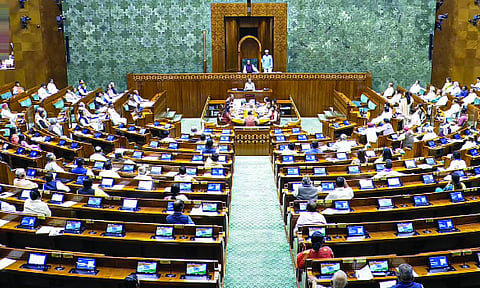

Ending months of speculation, the Centre on Thursday proposed a special sitting of Parliament from November 30 to transact “essential” business, amid indications that the delimitation-linked women’s reservation bill may be reintroduced.
The special sitting will extend the Monsoon Session. Parliament was adjourned sine die on August 13, but has not yet been prorogued-the formal ending of the session.
“The Government has requested the Hon’ble Speaker, Lok Sabha, and the Hon’ble Chairman, Rajya Sabha, to reconvene Lok Sabha on Monday, 30th November, 2026 and Rajya Sabha on Wednesday, 2nd December, 2026, respectively, to transact essential Government Business,” Union Minister Kiren Rijiju said on Thursday.
Subject to exigencies of the business, the sitting of both Houses may conclude on December 3, 2026, the Minister for Parliamentary Affairs announced on
social media.
Ahead of the special sitting of Parliament, the Union Cabinet will meet on Friday and is likely to discuss the delimitation-linked women’s quota bill, sources said.
The development comes on a day Prime Minister Narendra Modi asserted that no force can stop the delivery of justice to women and blamed “one Opposition party” for the defeat in Parliament of the delimitation-linked Constitution amendment bill, which would give 33 per cent reservation to women in legislatures.
In an article that appeared in major newspapers including The Pioneer on Thursday, Modi said, “The journey of our Constitution would be incomplete without recognising the remarkable women who helped shape it. But what happened earlier this year should fill our hearts with shame.”
The Prime Minister said the legislation aimed at giving women adequate representation in legislative bodies was blocked from passing by one opposition party, once again showing its “disdain for
constitutional values”.
“I assure the ‘Nari Shakti’ of India that no force can prevent us from ensuring that justice is done to them,” Prime Minister said.
Special Parliament session from November 30 amid Bill buzz
The Government has been keen to push through the Constitutional amendment bill for a long time. It seeks to expand the Lok Sabha’s strength from the existing 543 seats to a maximum of 850 through delimitation, paving the way for the implementation of 33 per cent reservation for women in Parliament and state legislatures ahead of the 2029 general elections.
The earlier Government move to pass the proposed legislation in Parliament was defeated in April due to a lack of numbers.
The Bill requires a two-thirds majority in the Lok Sabha, or 361 votes in the present 543-member House. With three vacancies, the House currently has 540 members.
The ruling NDA has around 320 members and would need the support of opposition parties to cross the threshold.
Since the Bill’s defeat in April, the political arithmetic has changed, with 26 MPs leaving the opposition camp.
Twenty rebel Trinamool Congress MPs broke away and merged with the Nationalist Citizens Party of India (NCPI), pledging support to the NDA, while six Shiv Sena (UBT) MPs joined the Eknath Shinde-led Shiv Sena.
While these developments have strengthened the government’s position, it would still need additional support. The role of the DMK, with 22 Lok Sabha MPs, and the NCP (Sharadchandra Pawar), with eight, could become significant in the evolving numbers game.
Opposition parties, which have stepped up their campaign against the Special Intensive Revision (SIR) of electoral rolls and demanded the resignation of Chief Election Commissioner Gyanesh Kumar, are expected to carry their protests into Parliament, potentially setting the stage for another stormy session.
A Lok Sabha MP said debate and voting on a Constitution amendment bill would not be possible unless the House functioned in an orderly manner.
