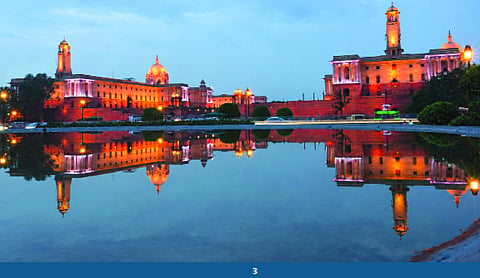

India’s journey to a developed nation and its rich cultural and civilisational heritage are the key features of the Yuge Yugeen Bharat Museum, formerly known as the South and North Blocks in the national Capital. Benchmarked against major international assemblages, this museum is billed to be the largest display area in the world. It will have eight thematic segments depicting India’s story spanning over 5,000 years.
Shedding the colonial legacy by rechristening the erstwhile power centres of the country, the Union Cabinet on Wednesday here approved the development of the museum through adaptive reuse of the existing complex, at an estimated total project cost of `3,230 crore, following its appraisal by the Public Investment Board (PIB). The Prime Minister first announced the establishment of the museum on May 18, 2023.
“The museum will be developed through the adaptive reuse of the North and South Block buildings, preserving their architectural character and heritage significance while transforming them into a public cultural institution”, the Cabinet Committee on Economic Affairs (CCEA) said.
“With a proposed built-up area of around 1,78,509 square metres, the museum is expected to have the world’s largest display area, with integrated contemporary museum practices, immersive technologies and visitor-centric interpretation,” the CCEA said.
The relocation of Government offices from the North and South Block buildings has opened the possibility of giving the historic structures a new public purpose. The museum is being designed to handle an annual footfall of around one crore visitors. It is expected to generate recurring revenue through ticket sales, food and beverage facilities, events, venue rentals, digital experiences, guided tours and retail outlets.
The first gallery, based on the theme of ‘Adornment’, is expected to open to visitors in the North Block in the latter half of 2027. The museum will follow a modular development model, allowing additional galleries to be introduced in phases. The Ministry of Culture has identified around 1.8 million objects from the National Museum and other museums under its jurisdiction, 52 Archaeological Survey of India site museums, state museums and private collections for possible display. The collection and content analysis is currently underway.
Other proposed galleries will cover themes including architecture and cityscapes, mathematics and astronomy, languages and scripts, faith and spirituality, and India’s historical links with the world through trade and ideas.
The museum will use curated galleries, exhibitions, immersive technologies and contemporary interpretation methods to present India’s tangible and intangible heritage. Proposed facilities include collection storage and conservation spaces, visitor amenities, landscaping, intelligent building systems, and supporting infrastructure.
The project aims to bring together India’s diverse cultural traditions, artistic practices, historical objects, and knowledge systems under a single institutional framework. The Government said its planning would follow international practices in museum design, heritage conservation and sustainable cultural management, adapted to India’s cultural context.
The museum is envisaged as a national public cultural institution, serving the general public, students, researchers, scholars, cultural practitioners, domestic and international tourists, and other visitors. As a public cultural and educational institution, it will provide opportunities for learning, research, cultural engagement and appreciation of India’s civilizational heritage. A fixed beneficiary count does not apply to this project.
The North Block earlier housed the Home Ministry, the Finance Ministry and other central Government offices. In contrast, the South Block housed the Defence Ministry and the Ministry of External Affairs, which have been moved to the newly-built Kartavya Bhawans near the India Gate complex.
The new Capital of Delhi was designed and built from 1912 to 1931 by Sir Edwin Landseer Lutyens, along with Sir Herbert Baker, and the two imposing buildings-North Block and South Block - along with the Rashtrapati Bhavan (earlier Viceroy’s House) form the centrepiece of the Raisina Hill complex. These iconic buildings were constructed as part of the new capital of Delhi, envisioned by the British Raj after the imperial capital was shifted from Calcutta (now Kolkata) to Delhi in 1911.
A MUSEUM OF CIVILISATIONS
· The total outlay is Rs 3,230 crore
· The museum is billed to be the largest display area in the world
· It will have eight thematic segments depicting India’s story spanning over 5,000 years
· The museum is being designed to handle an annual footfall of around one crore visitors
· It is expected to generate recurring revenue through ticket sales, food and beverage facilities
· The project aims to bring together India’s diverse cultural traditions, artistic practices