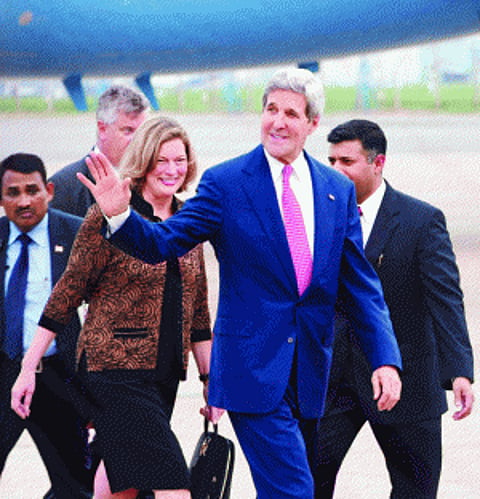

With the issue of snooping on Indian entities and the BJP by American agencies weighing heavy on her mind, External Affairs Minister Sushma Swaraj will meet US Secretary of State, John Kerry, at the fifth Indo-US Strategic Dialogue on Thursday. This will be the first high-level political engagement between the two nations after the change of Government in India.
Kerry’s visit is seen as US efforts to revitalise ties with India. Relations between the two nations took a hit over Indian diplomat Devyani Khobragade’s arrest and reports of NSA snooping on BJP leaders.The snooping issue is expected to figure prominently in the discussions on terrorism and cyber security related matters.
“There is considerable disquiet in the country on this issue and leaders do reflect public concerns. These issues are going to figure,” said Syed Akbaruddin, spokesperson for Ministry of External Affairs.
India expressed its displeasure and sought details from the top US diplomat in New Delhi soon after the news broke. Even though India did not formally criticise the PRISM surveillance programme made public following Edward Snowden’s revelations last year, the recent allegations of the NSA snooping on the BJP has created tension and Swaraj is expected to express India’s concerns.
Kerry arrived in New Delhi on Wednesday evening and was received by Joint Secretary (Americas) Vikram Doraiswami. Kerry is accompanied by a high-level inter-agency delegation. The strategic dialogue will be held under a restricted format, following a delegation-level meeting, as the two sides explore “transformative initiatives” for cooperation in areas of Defence and security; energy and climate change; science and technology; trade and investment, human resource development, health and innovation; regional and international issues.
“The Indo-US relationship is stable and mature. The meeting is to explore new frontiers to promote bilateral relationship and focus on convergence of wide areas. Prime Minister Modi will visit the US in the second half of September. This will be an opportunity for both Foreign Ministers to explore transformative initiatives that can take the Indo-US relationship to the next level,” said Akbaruddin.
Kerry will also meet Narendra Modi, Defence and Finance Minister Arun Jaitley and National Security Advisor Ajit Doval. Modi held a meeting with Swaraj and Jaitley to discuss various aspects expected to figure in his talks with Kerry.
In Washington, before starting his visit to India, Kerry had made it clear that the US would be exploring new opportunities and possibilities with the NDA Government. With India, the US has issues over protectionism and intellectual property rights. India’s muscle-flexing at the WTO too has left the US uncomfortable.
Kerry’s ambitious agenda includes convincing India for trade and investment liberalization. The US seeks India’s positive response to support a rules-based trading order to attract more investment from the US and around the world.Aware of Modi’s plans to get investment to the country, Kerry said if India gave greater space for private initiative, created more openness for capital flows, limited subsidies that stifle competition and provided strong intellectual property rights, many American companies would come running to India.
The American delegation’s effort will be to push trade and Defence deals from $100 billion to $500 billion a year. Kerry will also set the tone for a dialogue on Defence cooperation, tie-ups and deals that will be followed by US Defence Secretary Chuck Hagel when he tours India on August 7.
After the last strategic dialogue between Kerry and former External Affairs Minister Salman Khurshid, a joint statement talked about efforts to transform Defence ties beyond buyer-seller relationships and to pursue opportunities for technological cooperation for co-development and co-production of Defence equipment. However, with India putting a cap on ownership limits in the Defense sector, the US firms are unhappy with not getting the controlling stakes in joint ventures and might be reluctant to share technology with India.
On the nuclear energy issue, the US wants removal of obstacles on American firms’ participation in India’s nuclear power sector. The stringent civil nuclear liability law is seen as dampner by US nuclear industries to enter the Indian power sector.While Intelligence sharing between India and US on counter-terrorism and terror financing has improved substantially, India remains unhappy with the US blocking its request for access and extradition of lashkar-e-Taiba terrorist David Headley for his involvement in the 2008 Mumbai attacks. India also has issues relating to the new US immigration policy.