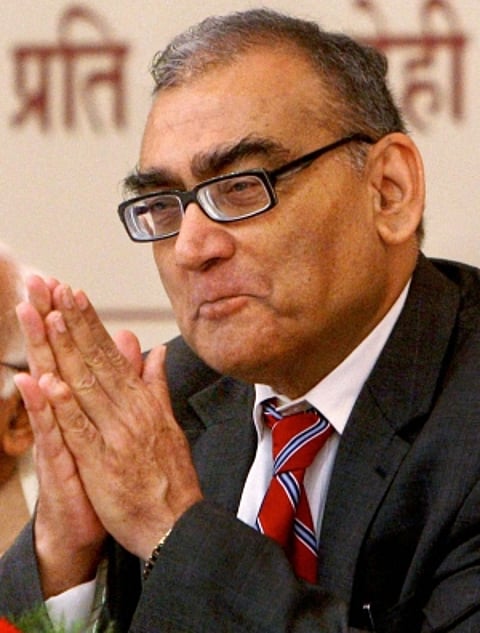

The Supreme Court on Friday did the unthinkable by issuing contempt notice against its former judge Justice Markanday Katju, who had written a scathing blog against sitting Supreme Court judges in September this year for acquitting one Govindaswamy of the charge of killing Soumya, a young woman from Kerala. The man was awarded life sentence over rape charges. The SC gave Justice Katju six weeks time to respond to the charge of contempt.
After the SC issued contempt notice, a defiant Justice Katju said, “Mr (Justice) Gogoi don’t threaten me. Do what you want. I am not scared.”
The day was historic as the SC Bench that was hearing the review petitions filed by the Kerala Government and Soumya’s mother, had decided to give a special hearing to Justice Katju after reading one of his blogs where he said that the Soumya judgment was wrongly decided by the three-judge Bench.
Katju’s blog said that the accused, Govindaswamy, ought to be hanged for murder of the girl and accused the judges of letting him off based on hearsay that suggested the girl had jumped out of a moving train on being assaulted by the accused inside the ladies compartment. The blog further stated that the impact of injuries inflicted by the accused on the deceased inside the train was sufficient to hold him guilty of her murder. Katju had suggested that it was not of consequence whether she was pushed out of the train or jumped out of it.
It was for the first time that a former Supreme Court judge got the privilege to argue in the same court from which he retired.
Katju’s submissions were effectively countered by Justices Ranjan Gogoi, PC Pant and UU lalit. They rebutted him by saying that law permits only to accept evidence as the IPC does not provide for any presumption for holding an accused guilty of murder. “It must be an act and that act alone should be responsible for the murder,” the Bench said, adding “before sentencing a man to death, we want to be 101 per cent sure.”
As Katju began peeling off the prosecution story layer by layer by reading out the accounts given by witnesses, the Bench was visibly annoyed. “The notice issued to you is limited to your blog on IPC Section 300 dealing with murder. If you go into other aspects of the case, we may have to examine your other blogs on hearsay evidence, which we have deliberately avoided for a reason you know well.”
An unfazed Katju shot back, saying, “You made a grave error by relying on hearsay evidence…there is something known as common sense that you need to apply for arriving at justice.”
Ignoring the early warning signs, Katju continued with his submissions, even finding support from Attorney General Mukul Rohatgi who appeared for the Kerala Government, counsels for victim’s mother and two other lawyers from the bar.
The Bench finally dismissed the bunch of review petitions, trashing each argument by Katju as well. But it was not over yet. The Bench handed over a copy of Katju’s other blogs demeaning judges of Supreme Court to the A-G for an opinion. Katju stood up and said, “It’s a free country, I have a right to say everything I want.” But the A-G took a different view. “It’s scandalous,” replied Rohatgi, prompting the Bench to issue contempt notice to Justice Katju.
As a stunned courtroom lapsed into silence, the A-G took a U-turn, “I change my position…the portions underlined in the blog are intemperate, not bordering on contempt.”
Katju got a lifeline as he shot back to the Bench, “You are provoking me by giving me these kind of threats. I am not scared of all this. I am senior to you as a judge and I respected your order and came to assist you in a case. I cannot be treated like this.”
The Bench lost its cool and sought a security official to forcibly escort Katju out of the courtroom. After some members of the bar protested, the Bench changed its mind but recorded in its order issuing contempt to Katju that his blog “prima facie seems to be an assault on the judges and not the judgment in question”.