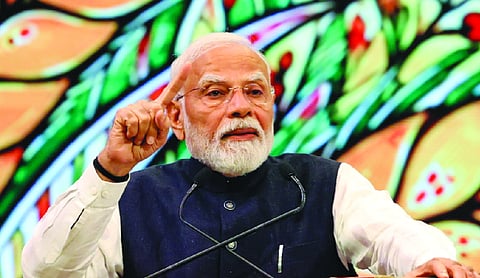

India abounds with “experts” who do not shy away from airing their opinions, be it cricket or any other endeavour. Every alley boasts of these people confidently picking holes in Sachin Tendulkar’s batting technique. Now, such knowledgeable people offer their views on every news story thanks to the media explosion driven by technology. This was Prime Minister Narendra Modi’s main refrain in a media interaction at a Diwali Milan programme organised by the BJP, here on Thursday.
Sharing interesting anecdotes, he noted, “From press releases to Insta reel releases, I have witnessed a long evolution of media and media interactions”. In the early 1990s, he recalled, he was entrusted with the responsibility of managing media arrangements across the country for two major yatras.
“And that was a time when one had to search for a fax machine just to send out a press release. When I came to Delhi, I still held this responsibility. At that time, the party operated from the Ashoka Road office,” PM Modi said. “Even during those times, these Diwali gatherings used to take place. My job back then was to arrange chairs at such Diwali gatherings and welcome all of you,” he said.
He told the story in parts while narrating an incident when he was about to be named Gujarat Chief Minister, which was a closely guarded secret. “One day, a group of journalists stormed into my room. Normally, journalists never treat me like that. But that day, they just barged in. And at that time, there used to be a women’s brigade. They possessed immense influence,” he said.
“Gala hi pakad liya unhone. Bola mithai khilao (They caught me by the neck and asked me to treat them with sweets),” Modi said. “I asked why they wanted sweets, and they said, ‘You are going to Gujarat to become the CM.’ I told them that I don’t know. They replied that they knew and that I was lying,” he said. Very few people knew about it at that time, but this group was already aware. “Anyway, their information was accurate, but it was very difficult for me to answer,” PM Modi said.
PM drew a parallel between traditional neighbourhood cricket critics-who routinely analysed players like Sachin Tendulkar in every alley-and modern self-appointed news commentators found on every street. “Today, everyone has their own platform, their own channel, and their own podcast,” Modi observed. He added that it used to be said that, in India, cricket experts could be found in every alley. “Someone in a village lane would explain what mistake Sachin (Tendulkar) made. Nowadays, experts on every piece of news are available in every street,” he said.
PM Modi said he had learnt a lot and many of his experiences from that time still prove very useful.
The prime minister also said that evolving technology has dramatically altered the nature of the media. “While the work of traditional media outlets has become somewhat easier, brand new challenges have also emerged. Earlier, there used to be a struggle for massive OB vans, but today, the mobile phone itself has turned into an OB van,” he said.
According to PM Modi, the one wonderful aspect about the world of news is that nothing is deemed impossible. “Whether an accident occurs, an earthquake strikes, or flood devastation ensues, the whole world runs away from that place. Yet the ones who swim against the tide are our field reporters. Risking their own lives and putting aside all concerns for their families, they reach the spot for coverage,” he said.
He urged the media fraternity to highlight India’s achievements and success stories, saying positive coverage of the country’s progress would help accelerate its journey towards becoming a developed nation by 2047.
Emphasising the importance of communication in the 21st century, the Prime Minister said the media had an important role to play in taking India’s story to the world. He also expressed confidence that India would achieve its goal of becoming a developed nation with the support of the media and the people.
“I have a request for the media; communication is the strongest tool in the 21st century, and we need to tell the ‘India story’ to the world. As deadlines are very important in the world of news, today, our country is also working toward a deadline. That deadline is the year 2047. The dream of making our country developed has been with us since independence. But now this dream has a set date, 2047. That means we must work together to make India a developed nation before we complete 100 years of independence,” he said. The prime minister said India possesses a young population, talent, technology, and affordable data, and, most importantly, the country has fascinating achievements to share with the world.
Listing India’s achievements over the past 12 years, PM Modi cited the country’s space programme, manufacturing capabilities, infrastructure development, and renewable energy expansion as examples of its progress toward becoming a developed economy. “There were slogans of ‘Garibi Hatao’. But this Government has removed poverty. According to the World Bank, 50 crore people have been elevated from the below poverty line in the last 12 years,” he said.
“Just think about all that India has accomplished in recent years. Who would have thought that India would make history by landing near the moon’s South Pole? Who would have thought that India would become the world’s second-largest mobile phone manufacturer?
“Who would have thought that the world’s highest railway arch bridge would be built over the Chenab River? In just 12 years, India has increased its solar generation capacity more than 50-fold. In just 12 years, India has built the world’s third-largest startup ecosystem,” he said.
Modi said the 2047 deadline does not mean India has to wait until then, as the country did during the freedom movement when it realised that the goal of complete freedom was not going to be achieved in a day or two.