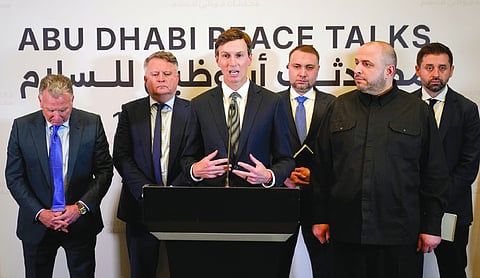

Russia and Ukraine have agreed in principle to conduct a major prisoner-of-war exchange following two days of US-mediated negotiations in Abu Dhabi. However, the discussions concluded without a significant breakthrough toward ending the nearly five-year-old conflict.
The meeting marked the first round of direct negotiations between the two countries in nine months. Despite limited progress on broader peace efforts, the proposed prisoner exchange was welcomed as an important humanitarian development.
Jared Kushner, son-in-law of US President Donald Trump, said both sides had agreed to move forward with what could become their largest prisoner release. He added that the final number of prisoners would be confirmed after further discussions.
Russian delegation leader Vladimir Medinsky and Ukraine’s chief negotiator Rustem Umerov also confirmed the agreement, although Medinsky described it as an understanding reached in principle.
Washington is attempting to revive diplomatic efforts to end the war, but several major disagreements continue to stand in the way of a settlement. Key issues include the future of Russian-occupied Ukrainian territories, security guarantees and the participation of European countries in negotiations.
Kushner said he and US special envoy Steve Witkoff would travel to Moscow to meet Russian President Vladimir Putin before heading to Dublin for discussions with Ukrainian President Volodymyr Zelenskyy.
Umerov said Ukraine’s delegation would also meet European government representatives, the European Union and NATO officials who were present in Abu Dhabi but excluded from the direct negotiations.
Moscow has expressed opposition to European participation in direct peace negotiations, accusing European governments of prolonging the conflict by providing Ukraine with financial and military assistance.
Kremlin spokesperson Dmitry Peskov indicated that European representatives could eventually join the discussions but questioned their willingness to contribute constructively.
Kushner stressed that European countries, the EU and NATO should participate in discussions about future security arrangements. Ukraine wants reliable guarantees against another Russian invasion, while European officials have argued that broader security discussions should follow a ceasefire.
Russia has repeatedly raised concerns about NATO’s eastward expansion and demanded changes to the alliance’s military presence near its borders.
The negotiations took place amid continued fighting along the front lines, with both countries carrying out missile and drone attacks.
Meanwhile, Russian strikes have severely damaged Ukraine’s electricity infrastructure, while Russia’s economy faces increasing pressure from the prolonged conflict.
Separately, Russian forces reportedly attacked a marketplace in southern Ukraine’s Odesa region, killing three people and injuring 11 others. Residential buildings were also damaged, according to regional military authorities.
Although the proposed prisoner exchange offers a positive humanitarian development, major political and territorial disagreements continue to prevent a comprehensive peace agreement.