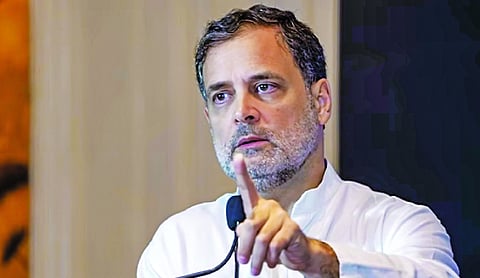

Upping the ante in their campaign against Chief Election Commissioner (CEC) Gyanesh Kumar, Congress leader Rahul Gandhi and other INDIA bloc leaders have filed a plea in the Supreme Court seeking permission to serve a list of 48 interrogatories on the Election Commission of India (ECI), Chief Election Commissioner (CEC) and other officials. The questions focus on the decision-making process behind the nationwide Special Intensive Revision (SIR) of electoral rolls that led to “vote chori”.
The new 48-question request comes despite the ECI filing counter-affidavits dated October 26 and a supplementary affidavit dated November 14, in which it declared that SIR orders were issued based on unanimous decisions by the poll body. However, INDIA bloc leaders have rejected these affidavits, saying the ECI still failed to disclose file numbers, dates, or meeting minutes to substantiate its SIR claims.
In an application filed in their pending petition, Rahul Gandhi and INDIA bloc leaders have sought sworn responses from the Deputy Election Commissioner, who had filed the poll panel’s counter-affidavit, the CEC and the two Election Commissioners on specific issues concerning the authorisation of SIR, the alleged exclusion of voters and changes made to the Commission’s online electoral registration systems. They questioned whether the Election Commission of India took decisions on the nationwide Special Intensive Revision (SIR) as a collective body, or whether the CEC exercised the EC’s powers without the knowledge, approval, or concurrence of the other Election Commissioners.
At the heart of the dispute is whether the CEC unilaterally used the poll authority’s powers without the knowledge, approval or concurrence of the other two ECs. In the questions posed to the CEC and the EC, Congress has asked how many decisions saw the other two Election Commissioners disagree with the Chief Election Commissioner’s opinion and who decided to conduct the SIR across the country. “…Who decided to conduct the SIR across the country? Who decided to change ‘Form 6’? Who decided to centralise ERONET and ECINET and keep the voter list under central control?” the party said on X. “Now, the INDIA alliance has sought the Supreme Court’s permission to question the CEC, the other two Election Commissioners and the Director General of IT. These questions concern the serious flaws in the SIR that paved the way for vote theft,” it said.
The application argued that the interrogatories are necessary to obtain detailed answers, backed by official records, on various aspects of the SIR exercise. It maintained that the information and documents sought are exclusively available with the Election Commission and that the questions are intended to verify the poll body’s own claims rather than initiate a fishing enquiry.
They also sought details of access to electoral roll databases, audit trails of voter additions and deletions, changes to Form 6, appeals against judicial officers’ orders in West Bengal, and the number of voters excluded during the revision. The petitioners have also sought records of decisions and approvals, including those obtained through electronic communications.
On the alleged differences within the Commission, the petitioners asked, “State the number of occasions, between 19.02.2025 and 26.10.2026, on which Dr Sukhbir Singh Sandhu or Dr Vivek Joshi recorded in writing an objection, dissent or reservation concerning any matter relating to the SIR, ECINET, Form 6 or the filing of appeals; and, for each such occasion, state its date, the file number and the subject matter.” “State whether any decision relating to the SIR has been taken by majority under Section 18(2) of the 2023 Act; and, if so, state the particulars of each such decision and identify the dissenting member,” it continued.
The petition referred to the EC’s admission that the declaration was incorporated into the online version of Form 6. It said the poll panel’s reply did not identify the persons who authorised the changes. “Allow the present application and grant leave to the Petitioners to deliver to the Respondents the interrogatories set out herein and direct that the same be answered by way of affidavit by persons of such identity as set out therein; and that copies of the records referred to in the answers be annexed thereto, and that any claim of privilege be stated specifically, record by record, with the grounds thereof, for adjudication by this Hon’ble Court,” it said.
The application argued that the Election Commission, as a constitutional authority entrusted with the superintendence, direction and control of the preparation of electoral rolls, ought to welcome the opportunity to place the facts before the court.
The petitioners have also raised questions about access to the electoral roll database and the auditability of changes made to voter records. They have sought details of officials and other entities authorised to add, delete, modify or restore entries in the database, including whether employees of private vendors or contractors have had privileged or write access.
The interrogatories further seek details of ECINET’s audit trails, including whether every alteration to electoral roll entries is recorded with the user account, date, time and corresponding order of the Electoral Registration Officer.
The application also seeks explanations on the online Form 6 process, including the introduction of a declaration and the number of applications rejected or kept pending because of the non-submission of the declaration or mapping details.
Interrogatories are a set of written questions that one party can send to another to obtain information with the court’s permission. Besides Gandhi, Congress President Mallikarjun Kharge, Saugata Roy, Akhilesh Yadav, Tejashwi Prasad Yadav, Sanjay Raut, MA Baby, D Raja, Mahua Majhi, Supriya Sule, ET Mohammed Basheer, Thol Thirumavalavan and Sajjad Ahmad Kichloo are the co-petitioners in the case.
The application also asked the EC to name the officer who decided to place the SIR declaration on the online Form 6 page. Another question asked what “electronic means” were used to obtain approvals from members in urgent cases, including whether WhatsApp or personal email was used and whether those messages had been preserved. Citing the Aadhaar judgment, the petitioners said the court had earlier allowed questions to be put to the UIDAI chief on the system’s architecture.
They said every question was tied to a specific averment and was not “a roving or fishing inquiry”. If the respondents decline to answer, the court should “draw an appropriate inference”, the application said.