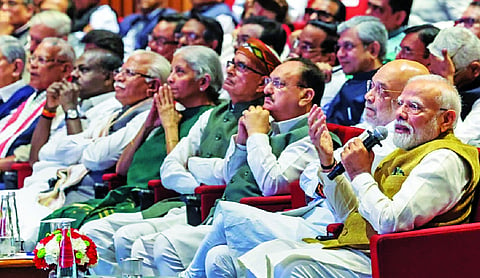

Amid the growing buzz over a Cabinet reshuffle, Prime Minister Narendra Modi on Wednesday chaired a meeting of the Council of Ministers at Bharat Mandapam. He called for decisive action against drug abuse to free the country from the menace, while urging officials to prevent the return of Naxalism in any form and step up efforts to eradicate poverty.
Modi made these remarks at a meeting of the Union Council of Ministers held at Bharat Mandapam, where 11 secretaries from various Union ministries and departments made presentations. The Prime Minister stressed the need to intensify efforts to ensure a “Drug-Free India” and directed all concerned to ensure the campaign’s success, according to a source.
At one point, while talking about the problems of narcotics, Modi turned emotional and said it has badly affected some areas of the country. The meeting began around 10 am, hours after PM Modi arrived in New Delhi following the India-ASEAN Summit in Manila, Philippines. During the meeting, which lasted about three and a half hours, they held extensive discussions on good governance priorities, policy matters, and ongoing initiatives.
The PM said that if 50 crore people could be elevated from below the poverty line and naxalism could be eliminated, the drug problem could also be eradicated. The comments assume significance with Punjab going to polls early next year, where the AAP Government’s handling of the drug problem has become a point of contention.
During the meeting, three key presentations highlighted the Government’s priorities and the status of key public welfare schemes. These included presentations on poverty eradication and the elimination of Naxalism.
The meeting also hailed the Modi Government’s poverty alleviation programmes. It cited the World Bank report that said that 50 crore people have been moved out of poverty between 2011 and 2023, causing the extreme poverty rate to plummet by 90 per cent — from more than one in four Indians to roughly one in thirty-eight.
At the meeting, the prime minister told his ministers to ensure that all Government schemes are people-centric and that their benefits reach the common person.
He also sought feedback from ministers on the targets assigned to them during the September meeting of the Council of Ministers. The key focus of the meeting was to ensure that the benefits of Government schemes reach the last person and that the objectives of good governance do not remain confined to paperwork.
The Council of Ministers conducted a detailed review meeting to evaluate the progress of various ministries. The discussions followed the Prime Minister’s return from Manila and focused solely on performance evaluations, without addressing any speculation about a ministerial reshuffle.
Several issues, including governance, reforms, and outreach to women and youth on welfare and development schemes, were also discussed at the meeting, according to a source.
The session revisited tasks assigned during the September Chintan Shivir and featured three presentations addressing critical governance areas such as poverty alleviation and countering left-wing extremism.
In the September meeting, the council of ministers was divided into eight groups, and the prime minister interacted with each of them, while also addressing them together.