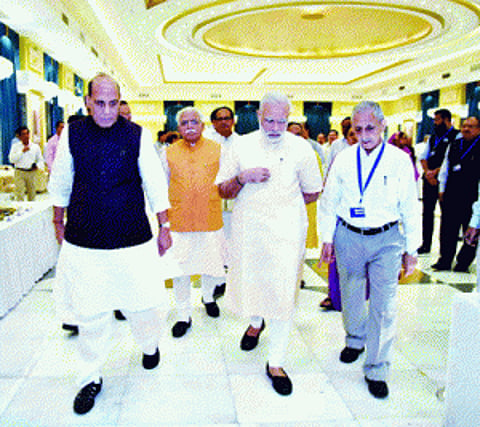

Prime Minister Narendra Modi on Saturday sought the cooperation and consensus of all Chief Ministers for the overall development of the country, delivery in governance to the common man and better Centre-State relations. Addressing the Inter-State Council meeting, convened after a gap of 10 years, the Prime Minister also sought the Chief Ministers’ collective cooperation in Intelligence sharing and action to counter the challenges to internal security.
Modi said internal security cannot be strengthened until and unless States and the Centre focus on sharing Intelligence. “We have to remain alert and updated always,” he said while stressing for “stern actions” on issues related to internal security.
Chief Ministers of all States, lieutenant Governors of Union Territories and 17 Union Ministers are members of the Inter-State Council.
Modi highlighted the increase in State’s share of central taxes with the acceptance of the 14th Finance Commission’s recommendations and more revenue to States through coal block auctions even as he pointed out that States could have an additional Rs1,600 crore for themselves this year if they reduced consumption of kerosene by 25 per cent. He also talked about efforts to ensure release Rs40,000-crore CAMPA funds for States.
“With close cooperation, we will not only strengthen the Centre-State relations but make a better future for the citizens,” he said, adding, “It would be difficult for any Government to successfully implement a scheme on its own.
Therefore, provision of adequate financial resources is as important as the responsibility for implementation.”
Citing there are only a few occasions when the leadership of the Centre and the States assembles together, he said, “This forum of cooperative federalism is the perfect setting to deliberate on the interests of the people, address their problems, and take collective and concrete decisions. It highlights the vision of the makers of our Constitution.”
Modi also said Inter-State Council is an inter-governmental forum that can be used for evolving policy as well as ensuring its implementation.
“The more we are able to forge consensus on these vital issues, the better we shall be able to tackle them. In doing so, we shall not only strengthen the spirit of cooperative federalism and Centre-State relations, but also secure a better future for our citizens,” he said.
The Prime Minister noted that with the acceptance of the 14th Finance Commission recommendations, the States’ share in Central taxes has increased from 32 per cent to 42 per cent. “This means that States now have greater financial resources to utilise in accordance with their requirements. I am happy to share that the total amount received by the States from the Centre during 2015-16 is 21 per cent higher than the amount received in 2014-15. Similarly, Panchayats and Urban local Bodies will receive Rs 2,87,000 crore during the period of the 14th Finance Commission, which is substantially higher than last time,” he said.
The rights of States have been kept in mind, even in revenue received from the auction of natural resources, he stressed.
“Auctions of coal blocks will yield 3.35 lakh crore rupees to States in the years to come. Auctions of other mines will yield an additional 18,000 crore rupees to States,” he said.
The Prime Minister said that through amendments to CAMPA Act (The Compensatory Afforestation Fund Bill), the Central Government was making attempt to free up about Rs 40,000 crore lying idle in banks for disbursal to States.
Modi said another important area of discussion in the Inter-State Council is education. He said India’s greatest asset is its youth as more than 30 crore children are currently of school-going age and hence, the country has the potential to provide the world with skilled manpower for many years to come.
The Prime Minister said the best way of improving the standard of education among children is to make them aware of the purpose of education.
“Merely going to school is not education. Education should generate curiosity among children. It should teach them how to attain and enhance knowledge. It should motivate them to continuously keep earning throughout their lives.
“Given the kind of efficiency and ability that is required in the economy of the 21st century, it is our responsibility to ensure that our youth are equipped with at least some skill-sets. We have to prepare our youth to think logically, think out of the box, and work creatively,” he said.
Referring to the Aadhaar card, Modi said the passage of Aadhaar Act, 2016 enables the Government to use Aadhaar for Direct Cash Transfers for subsidy and other services. “As on date, 102 crore Aadhaar cards have been distributed in our country of 128 crore people. 79 per cent of our people now have Aadhaar cards. Among adults, 96 per cent people have Aadhaar cards. With your support, we shall connect every citizen of the country with an Aadhaar card by the year-end,” he said.
He also praised the Congress-ruled Karnataka Government for moving swiftly on this initiative and sending its proposal to the Petroleum Ministry. “This has been accepted and the grant has been disbursed to the state government. If all states decide to reduce kerosene consumption by 25 per cent, and actually do so, they can receive about 1600 crore rupees as grant this year,” he said.
For his part, Home Minister Rajnath Singh also batted for close cooperation between the States and the Centre, saying without it, development projects are bound to suffer. “We want that the Centre and States, through close and active cooperation and collaboration, formulate development- related policies and implement them.
“It is quite natural to have an adverse impact on execution of development projects if there are differences of opinion between the States as well as between the state and the Centre,” he said
Singh said the creation of NITI Aayog, after disbanding Planning Commission, was part of the strengthening process of cooperative federalism. He said with the creation of NITI Aayog, the inherent deficiencies of the erstwhile Planning Commission’s ‘one size fits all’ policy have been filled. “Now every State can formulate and implement schemes as per their respective needs,” he said.