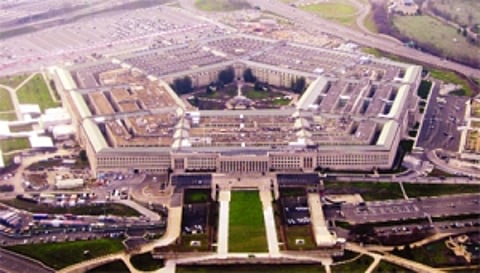

A newly-released Pentagon report has pointedly blamed Pakistan for its use of militants as proxies to counter India’s superior military and as a hedge against the loss of its own influence in Afghanistan.
The report, primarily dealing with the progress towards security and stability of Afghanistan, brings up the issue of continuing terrorist attacks from sanctuaries in Pakistan and raises questions on Islamabad’s commitment to support Afghan-led reconciliation.
“Afghan-and Indian-focused militants continue to operate from Pakistan territory to the detriment of Afghan and regional stability. Pakistan uses these proxy forces to hedge against the loss of influence in Afghanistan and to counter India’s superior military,” says the report in its latest six-monthly report to US Congress on the Afghan situation.
“These relationships run counter to Pakistan’s public commitment to support Afghan-led reconciliation. Such groups continue to act as the primary irritant in Afghan-Pakistan bilateral relations,” it points out.
Referring to Islamabad’s bid to limit Indian influence in Afghanistan, the report notes: “Although stability in Afghanistan is in the interest of Pakistan, Pakistan also seeks sufficient Pashtun representation in the Afghan Government to prevent Pashtun discontent along the Afghan-Pakistan border and limit India’s influence.”
The relationship between Afghanistan and Pakistan continues to pose a significant challenge to the stability of the region, says the report, observing: “Cross-border incidents and lingering mistrust remain points of tension in Pakistan-Afghanistan relations.
Both countries continue to question each other’s commitment to advancing a political settlement in Afghanistan.” India and Afghanistan, in contrast, believe a secure and stable Afghanistan will benefit the region and facilitate economic corridors into Central Asia, notes the report, pointing to their signing of a strategic partnership declaration in 2011, formalising cooperation in various areas, including security and law enforcement.
“India supports a variety of high-visibility projects and initiatives in Afghanistan. These ventures are focused primarily on major infrastructure projects, including electricity generation and transmission, road construction, and mining,” says the report.
While not providing direct military support or training in Afghanistan, India currently offers training to ANSF personnel in India across a number of specialties and New Delhi is committed to expand this programme.
The Pentagon report refers to the militant attack in May on the Indian Consulate in Herat, noting that it came just three days before Prime Minister Narendra Modi’s swearing-in ceremony. The State Department came out with a statement subsequently that lashkar-e-Tayyeba was responsible for the attack.
Coming just ahead of the year-end completion of the drawdown of US troops from Afghanistan that would leave behind just a residual American force essentially on a training mission, the report commends Afghan security forces for holding together against a “resilient insurgency” and defeating its objective of disrupting the country’s presidential election.