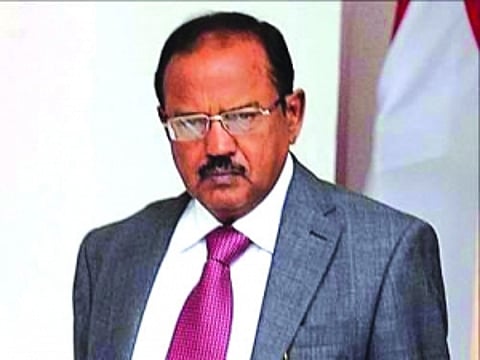

Indian National Security Advisor Ajit Doval and his Chinese counterpart Yang Jiechi met here on Thursday on the sidelines of a Brazil, Russia, India, China, South Africa (BRICS) meeting, amid an ongoing military standoff between the two nations in Sikkim.
According to China’s State-run Xinhua news agency bilateral relations, international and regional issues, multilateral affairs and “major problems” were discussed during the meeting.
It did not say whether the Sikkim imbroglio was raised during the Doval-Yang meeting.
Indian officials in Beijing too have not elaborated on the issues discussed between Doval and Yang, who are special representatives of their countries for the boundary talks.
Meanwhile, in New Delhi, External Affairs Ministry spokesperson Gopal Baglay continued to maintain that diplomatic channels were “functional” to resolve the ongoing standoff in Doklam.
“I think that you are presuming. I will not give a direct answer... There are diplomatic channels. We (both India and China) have embassies which are functioning. The embassies are under bodies of the MEA,
which is under the External Affairs Minister,” Baglay said, when asked by the media why the Foreign Ministers of India and China are not talking to each other.
He also did not reply to a question on whether there was any hope of a resolution during the China visit of Ajit Doval.
Baglay only said his visit was in the context of the two-day meeting of NSAs of BRICS nations hosted by Yang.
A joint meeting of the NSAs will take place on Friday and the media will be allowed to cover that meeting. Doval and other heads of the delegations will also call on Chinese President Xi Jinping on Friday evening.
Yang also separately met his counterparts from South Africa and Brazil, Xinhua reported.
Doval’s visit has raised expectations about the likelihood of a solution to the more-than-a-month-long military standoff in Doklam area near the Bhutan trijunction.
The standoff began after Indian troops stopped the Chinese Army from building a road in the area.China claimed it was constructing the road within its territory.
India protested the construction, fearing it would allow China to cut India’s access to its northeastern States.
last week, External Affairs Minister Sushma Swaraj told Parliament that both sides should first pull back their troops for any talks to take place, favouring a peaceful resolution of the border standoff.
Sushma also said that the “unilateral” Chinese action to change the status quo near the Bhutan trijunction poses a challenge to India’s security.
China has maintained that there won’t be a meaningful dialogue without the unconditional withdrawal of Indian troops from the area. But both sides have acknowledged that talks were held through diplomatic channels to ease the tension.