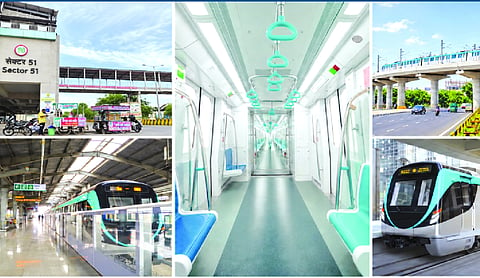

Commuters travelling between Noida and Greater Noida West could soon get better Metro connectivity, as the Union Cabinet on Wednesday approved the extension of the Aqua Line Metro Rail Corridor from Sector 51 to Greater Noida Sector 4. The proposed 8.5-km elevated corridor, estimated to cost Rs 2,390 crore, will have five elevated stations and is expected to be completed within four years. Once operational, Noida and Greater Noida will have 71.878 kilometres of active metro rail network.
The move also aims to improve connectivity and access to commercial, residential, and institutional hubs along the route. A key feature of the extension will be an interchange facility with the Delhi Metro’s Blue Line at Noida Sector 61, giving commuters an additional connection to the wider Delhi-NCR Metro network.
Prime Minister Narendra Modi, in a post on X, shared the “good news” and highlighted key advantages of the extension. “As Noida and Greater Noida grow, why should daily commutes become longer? Here is some good news for the people of Noida and Greater Noida!” PM Modi said. He said the extension would improve access to “offices, schools, hospitals and commercial hubs”, ease congestion and lead to shorter commute times. The proposed corridor would provide a “major boost to connectivity and ease of living,” the Prime Minister added.
The extension is expected to improve connectivity between Greater Noida West and the Delhi Metro network, making daily travel easier for residents and office-goers. It will provide an interchange with the Delhi Metro at Noida Sector 61, allowing passengers to access other parts of the National Capital Region (NCR).
Soon after the cabinet announcement, the Noida Metro Rail Corporation (NMRC) said it has selected a civil construction contractor for the metro extension project to Greater Noida Sector 4, with construction work expected to commence soon. The NMRC also said in a statement that work is underway on two more-line extensions — the 11.56-km Botanical Garden-Sector 142 corridor, comprising eight stations, and the 2.60-km extension from Depot Station to the Boraki Multi-Modal Transport Hub (MMTH), which will have two stations.
The proposed corridor will expand the operational metro rail network across Noida and Greater Noida to 71.878 km, while improving connectivity to several commercial and employment hubs, Union Minister for Information and Broadcasting Ashwini Vaishnaw told reporters at a Cabinet briefing.
These include Gaur City Mall, H&S Mall, Blue Sapphire Mall and commercial developments in Greater Noida’s Sector 4. It will also provide better access to IKEA in Noida’s Sector 51 and Anthurium Mall in Sector 73. The project is expected to provide better connectivity to areas that currently have limited efficient public transport links and integrate them with the existing metro network. The route is expected to serve offices and employment hubs, including Tech Mahindra and TCL Tech in Sector 60, the Oil Industry Development Board in Sector 73, and Golden I commercial space in Greater Noida Sector 4.
The extension is particularly significant for residents of Greater Noida West, where residential development and population growth have increased demand for public transport. It will also improve access to educational and healthcare facilities, including Delhi Public School in Sector 122, Kailash Hospital, Rama Hospital in sectors 70 and 62, and Cloud9 Hospital in Sector 51. Residential areas such as Cleo County in Sector 122 and Gaur City 1 and 2 in Greater Noida Sector 4 are also expected to benefit.
Better Metro connectivity is expected to make daily commuting more convenient for employees, students and residents. By encouraging commuters to shift from private vehicles to public transport, the project is also expected to support more sustainable urban mobility and help reduce pollution.
Noida and Greater Noida have emerged as major residential and commercial centres in the NCR. According to the project’s background presentation, the combined population of the two planned cities increased more than threefold, from 7.39 lakh in 2011 to an estimated 24.7 lakh in 2021, as per the master plan. The growing population and expansion of residential sectors have increased the need for better public transport links, particularly in Greater Noida West.
The new corridor is expected to improve access to public transport and reduce dependence on private vehicles. It could also help ease traffic congestion at busy locations such as Parthala Chowk, Gaur Chowk and Ek Murti Circle.
The proposed connectivity will help commuters reach the Indira Gandhi International (IGI) Airport through the Magenta Line. Passengers will also be able to travel to New Delhi, Anand Vihar, and Hazrat Nizamuddin railway stations via the Blue Line. The corridor is also expected to improve access to the upcoming Multi-Modal Transportation Hub at Boraki. From there, commuters will be able to connect with the Regional Rapid Transit System (RRTS) corridor towards Noida International Airport at Jewar and Hindon Airport. The extension is expected to strengthen public transport connectivity across Noida and Greater Noida West as the region continues to expand.