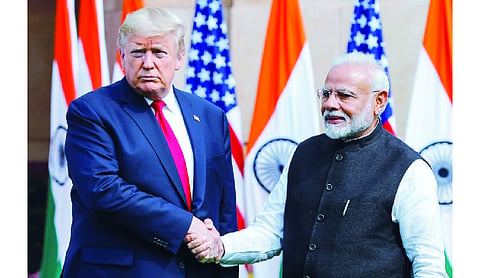

As global leaders converge on the Philippine capital for the ASEAN and East Asia summits, a possible meeting between Narendra Modi and Donald Trump, alongside an anticipated Quad leaders’ gathering, could place Manila at the centre of Indo-Pacific diplomacy
Manila is emerging as a potentially significant diplomatic destination as world leaders prepare to assemble in the Philippine capital for the ASEAN and East Asia summits. The possibility of a meeting between Indian Prime Minister Narendra Modi and US President Donald Trump, coupled with expectations of a high-level gathering of the Quadrilateral Security Dialogue (Quad), could give this year’s regional meetings importance that extends well beyond Southeast Asia.
The Philippines is scheduled to host the ASEAN Summit from November 16 to 18, bringing together several influential leaders, including Modi, Trump, Japanese Prime Minister Sanae Takaichi and Chinese Premier Li Qiang. Chinese President Xi Jinping’s absence is another notable feature of the gathering, particularly as strategic competition across the Indo-Pacific continues to intensify.
According to multiple diplomatic sources who spoke to The Pioneer, discussions are underway on a possible Quad leaders’ meeting in Manila on November 17. If it materialises, the gathering would represent an important moment for the four-member grouping comprising India, the United States, Japan and Australia.
The proposed meeting would be the first Quad leaders’ summit since September 2024 and the first during Trump’s second term as US president. Its proposed location is equally significant. Traditionally, Quad leaders have convened in one of the four participating countries. Hosting the summit in Manila would break that pattern, making the Philippines the first country outside the grouping to provide the venue for a leaders-level meeting.
Such a development would carry considerable diplomatic symbolism. It would reflect Southeast Asia’s growing importance in shaping the Indo-Pacific security architecture and highlight the Philippines’ expanding role in regional strategic affairs.
The Quad leaders are expected to explore ways to deepen cooperation across a broad range of issues, including maritime security, critical technologies, AI, energy security, economic resilience and diversified supply chains. Maintaining stability in the Indo-Pacific and safeguarding freedom of navigation are also likely to feature prominently.
Although the grouping maintains that it is not a formal military alliance, its growing strategic relevance is closely linked to concerns about China’s expanding influence and increasingly assertive activities across the region.
For New Delhi, the Manila meetings could offer an important opportunity to advance India’s regional priorities. Southeast Asia occupies a central position in India’s Act East Policy. At the same time, the Quad has become an important platform for strengthening cooperation with key partners on maritime, economic and technological issues.
Alongside the proposed Quad engagement, the possibility of direct talks between Modi and Trump is attracting considerable attention.
The two leaders last met on the sidelines of the G7 Summit in France in June. Since then, India-US relations have faced several difficult issues, including trade disputes, tariff policies, immigration, energy-related differences and Washington’s engagement with Pakistan’s military establishment.
A meeting in Manila could allow both governments to take stock of the relationship, manage differences and identify areas where strategic cooperation can be strengthened.
For India, maintaining a stable and productive relationship with Washington remains an important foreign policy priority. For the Trump administration, continued engagement with New Delhi is significant to its broader Indo-Pacific approach, particularly as competition with China shapes American regional policy.
Indian officials have yet to confirm a bilateral meeting formally. However, interactions between leaders on the margins of major multilateral gatherings are often arranged through diplomatic channels on short notice.
The domestic political context in the United States also adds another dimension to Trump’s possible Manila engagement, particularly following setbacks for the Republican Party in the US midterm elections. For Modi, the summit provides an opportunity to reinforce India’s diplomatic standing and its position as a consequential power in the Indo-Pacific.
The convergence of ASEAN diplomacy, possible India-US engagement and a proposed Quad summit could make Manila one of the most closely watched diplomatic venues of November.
For the Philippines, hosting such a gathering would offer an opportunity to strengthen its profile in regional security discussions. It would also demonstrate how Southeast Asian countries are becoming increasingly important stakeholders in debates concerning maritime stability, economic security and the evolving balance of power.
The broader significance of the meetings will depend on whether leaders can translate diplomatic engagement into practical cooperation. Statements supporting a free, open and inclusive Indo-Pacific have become a familiar feature of regional diplomacy. The challenge now is to build tangible mechanisms that can address emerging security and economic challenges.
If both the Modi-Trump interaction and the proposed Quad summit take place, Manila could deliver a significant diplomatic moment, bringing together bilateral priorities and wider regional ambitions.
At a time when geopolitical alignments are evolving, and strategic competition is reshaping the international order, the Philippines could find itself at the centre of a conversation that extends far beyond ASEAN. The outcome may help determine whether Indo-Pacific cooperation enters a more active phase or remains largely defined by diplomatic commitments.