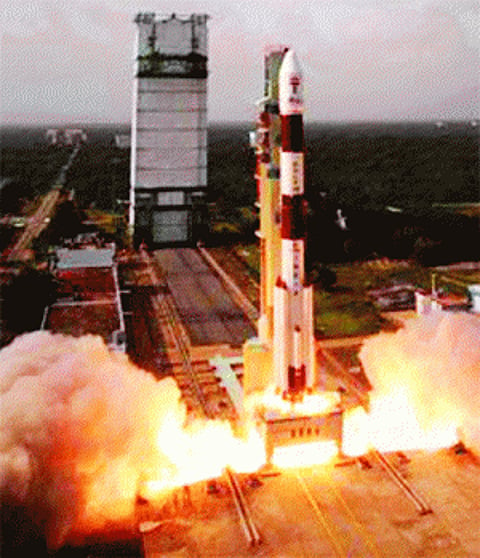

India on Tuesday took the first baby steps in its ambitious journey to Mars, the Red Planet. At 2.38 pm sharp, the Polar Satellite launching Vehicle (PSlV) C25, with a 1,340-kg Mars Orbiter Mission (MOM) spacecraft named ‘Mangalyaan’, successfully lifted off from the Satish Dhavan Space Centre at Sriharikota in Andhra Pradesh to mark India’s maiden inter-planetary exploration.
“It was an excellent mission and everything went on as per the script prepared by our team of scientists and engineers,” said K Radhakrishnan, chairman, ISRO. Asked if ISRO was in a race with neighbouring China, he said, “We are not in race with anyone. We are in race with ourselves.”
But the real test for the ISRO engineers begins on November 7, when they start the process of raising the spacecraft from its present elliptical orbit to another orbit to facilitate its odyssey to Mars. The spacecraft carries a 15-kg payload to observe and study Mars, which is 400 million km away from earth.
December 1, when Mangalyaan leaves the earth’s sphere of influence, and September 24, 2014, when it is captured by Martian orbit, will be two other key dates. ISRO officials said the spacecraft would go around the earth for 25 days before the ISRO does a trans-Mars injection at 0.42 hours on
December 1 enabling it to undertake the long voyage towards Mars and estimate where the satellite would be on September 24, 2014 — plus or minus 50 km from the designated orbit around Mars (366 kms X 80,000 km).
The ISRO chairman said the maneuvering of the spacecraft on December 1 is going to be the most crucial operation when its velocity has to be increased to 1.3 km per second.
Two ships Nalanda and Yamuna stationed by the ISRO in the South Pacific Seas sighted the Mars Orbiter separating from the launch vehicle. Exploration of the Red Planet’s surface features, morphology, mineralogy and Martian atmosphere by indigenous scientific instruments are among the Mission’s scientific objectives. The Mission will also help ISRO develop further the technologies required for design, planning, management and operations of more inter-planetary explorations.
The launch of the spacecraft was a routine affair for the ISRO as the PSlV has emerged as the country’s workhorse for all kind of low earth orbit launches. The spacecraft carries a series of liquid apogee motors (lAM) which has to be fired during the 10-month period of its journey to Mars for raising it from one orbit to higher orbits using limited energy.
The Mars Orbiter has five scientific instruments — lyman Alpha Photometer (lAP), Methane Sensor for Mars (MSM), Mars Exospheric Neutral Composition Analyser (MENCA), Mars Colour Camera (MCC) and Thermal Infrared Imaging Spectrometer (TIS). European Space Agency (ESA) of the European consortium, National Aeronautics and Space Administration (NASA) of the US and Roscosmos of Russia are the three agencies which have successfully sent their missions to the Red Planet.
BJP’s prime ministerial candidate Narendra Modi was the first to congratulate the ISRO for the successful launch of the Mars Mission. President Pranab Mukherjee, Prime Minister Manmohan Singh and Congress president Sonia Gandhi also congratulated ISRO for the Rs 460-crore mission. Former ISRO chairman Dr Madhavan Nair, who had earlier expressed his reservations over the Mars Mission, said, “First travelling to this large distance itself is a challenge. We have to watch till the next September for it to reach the Mars.”