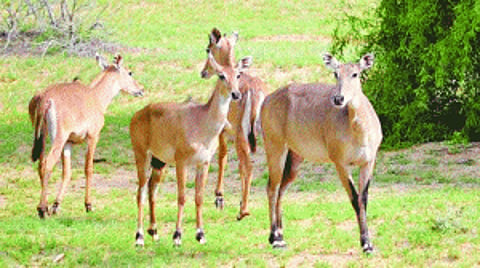

Union Environment Minister Prakash Javadekar on Thursday faced the wrath of his Cabinet colleague Maneka Gandhi after his Ministry declared the nilgai as vermin in Bihar, leading to the culling of 300 such animals. Maneka is also furious over the recent declaration of common Rhesus monkey a vermin in Himachal Pradesh and wild boar in Uttarakhand paving the way for their culling. She accused the green Ministry of showing a “lust for killing animals”.
last week professional shooters were brought from Hyderabad to cleanse the Tal area in Mokama in Bihar from the menace of nilgai. local MlC from JD(U) Neeraj Kumar, at whose behest the culling operation was launched, defended his actions saying lakhs of hectares of standing crops are flattened every year, for which there is no compensation from the Government.
Kumar’s explanation, however, made little impact on Maneka, who termed the operation as the “biggest-ever massacre”.
The Environment Ministry, on the other hand, clarified that the steps have been taken under the provision of the Wildlife Protection Act. Accordingly, any animal listed in Schedule I-IV can be put in Schedule V for a specific period, declared as vermin and killed. Schedule V includes animals like the common crow, fruit bats, mice and rats.
Responding to Maneka’s charges, Javadekar said, “Scientific management of animal population and the permissions for killing animals designated as vermin were restricted to particular areas and time period. It is being done as per the provisions of law and is not a Central Government programme.”
“When State Governments write to us about farmers and the common man suffering due to crop damage by such animals, only then such permissions are given, on the basis of recommendation of the State Governments,” said Javadekar.
Maneka retorted saying that the Environment Ministry “is writing to every State Government, allowing them to provide a list of animals that can be killed so that the Centre can give permission. This is happening for the first time…”
According to her, the Centre has allowed killing of nilgai (blue bull) in Bihar, elephants in West Bengal, monkeys in Himachal Pradesh, peacocks in Goa and wild boars in Chandrapur even when the Wildlife Departments of the States say that they do not wish to kill animals. She pointed out that 53 wild boars have been killed in Chandrapur in Maharashtra and the Environment Ministry has allowed killing of 50 more.
The latest notification of Environment Ministry in this regard came on May 31 to Himachal Pradesh. It read, “The State of Himachal Pradesh has reported damage to life and property including large scale destruction of agriculture by Rhesus Macaque monkeys in areas outside forests. The Central Government has considered it necessary to mitigate the damage to human life, crops and other properties of the State for ensuring conservation of wildlife in forests.”
Monkeys are a protected species under Schedule II of the Wildlife (Protection) Act 1972. The experts in the Ministry, however, explained that if any wild animal poses danger to human life or property (including standing crops), or is disabled or diseased beyond recovery, the law allows for its killing. Accordingly, monkey has been declared a vermin in 10 out of 12 districts including Chamba, Kangra, Una, Bilaspur, Shimla, Sirmour, Kullu, Hamirpur, Solan and Mandi. Earlier in March 2016, the Ministry had used similar notification just for the capital city of Shimla.
“The notification by the Ministry came after repeated requests from the Himachal Pradesh authorities, which cited rising cases of monkeys destroying property, including crops, and biting people,” pointed out the sources.
The animal welfare organisations have, however, come in support of Maneka. According to Poorva Joshipura, CEO of People for the Ethical Treatment of Animals (PETA) India, forests are being bulldozed down and humans encroaching into the habitat of animals, leaving them nowhere to go.
The Government must think twice before approving projects that damage forests, and they must work with farmers and scientists in developing humane and effective solutions as fencing, noisemakers, planting chili plants, etc., to repel them. Killing is certainly not the solution, she stressed.