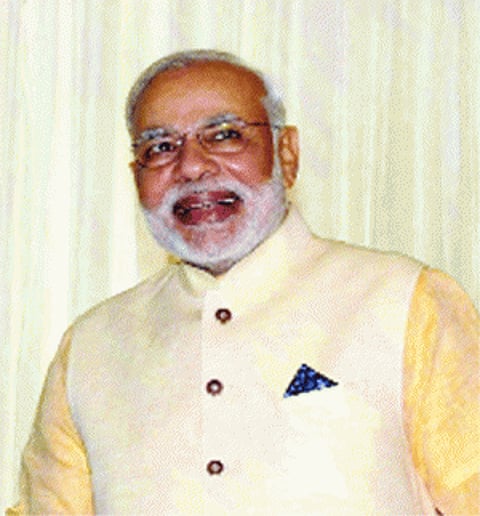

Prime Minister Narendra Modi and President Barack Obama are in agreement that it is time to set a new agenda for US-India partnership — one that realises concrete benefits for citizens of both countries. “This will be an agenda that enables us to find mutually rewarding ways to expand our collaboration in trade, investment and technology that harmonise with India’s ambitious development agenda, while sustaining the United States as the global engine of growth,” they wrote in a joint editorial in The Washington Post ahead of their Oval Office meeting on Tuesday.
Titled A renewed US-India partnership for the 21st Century, the editorial initiative is a first of its kind in US-India affairs. Written after a series of “digital” consultations, the piece apparently pins its hopes on the turnaround in relations on the newly-installed BJP-led NDA Government.
“The advent of a new Government in India is a natural opportunity to broaden and deepen our relationship. With a reinvigorated level of ambition and greater confidence, we can go beyond modest and conventional goals,” it said, after noting that the true potential was still to be realised from an otherwise “robust, reliable and enduring” partnership.
In a preview of their discussions, the two leaders wrote: “We will discuss ways in which we can boost manufacturing and expand affordable renewable energy, while sustainably securing the future of our common environment. We will discuss ways in which our businesses, scientists and Governments can partner as India works to improve the quality, reliability and availability of basic services, especially for the poorest of citizens.”
Significantly, the write-up affirms US support for Modi’s pet “Clean India” project as well. “The United States stands ready to assist,” it said, noting that “an immediate area of concrete support is the “Clean India” campaign, where we will leverage private and civil society innovation, expertise and technology to improve sanitation and hygiene throughout India”.
That a lot has happened in bilateral relations over the past decade and a half is conceded by both Obama and Modi, noting: “Our relationship involves more bilateral collaboration than ever before — not just at the federal level but also at the State and local levels, between our two militaries, private sectors and civil society. Indeed, so much has happened that, in 2000, then-Prime Minister Atal Bihari Vajpayee could declare that we are natural allies.”
The two leaders cast the strategic partnership in a global perspective, saying it would benefit not just their people, but the world at large. “While India benefits from the growth generated by US investment and technical partnerships, the United States benefits from a stronger, more prosperous India. In turn, the region and the world benefit from the greater stability and security that our friendship creates. We remain committed to the larger effort to integrate South Asia and connect it with markets and people in Central and Southeast Asia,” Modi and Obama noted.
In specific terms, they committed themselves to enhancing their homeland security by sharing intelligence, through counterterrorism and law-enforcement cooperation, and working jointly to maintain freedom of navigation and lawful commerce across the seas.
While referring to India’s recent successes in space exploration, with a satellite orbiting Mars alongside America’s own, they stressed: “The promise of a better tomorrow is not solely for Indians and Americans: It also beckons us to move forward together for a better world. This is the central premise of our defining partnership for the 21st century. Forward together we go — chalein saath saath.”