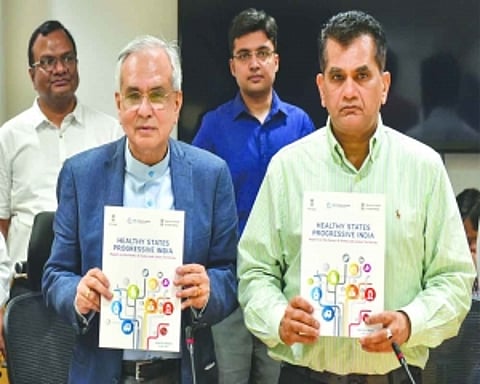

Andhra, Maha too at the top of NITI Aayog health index
Kerala, followed by Andhra Pradesh and Maharashtra, has emerged as the best health performer, while five States — Uttar Pradesh, Bihar, Uttarakhand, Madhya Pradesh and Odisha — saw a decline in the overall health index score and “only about half the States and UTs had an improvement in the overall score between 2015-16 and 2017-18”, reveals the second edition of health index released by NITI Aayog on Tuesday.
The health index is a composite measure of States and Union Territories calculated on the basis of health indicators with weightages on the basis of outcome. In other words, the index is supposed to provide a comprehensive view of health outcomes, while taking into account the efficacy of governance, policies, processes and interventions.
The decline in the overall health index score for five Empowered Action Group (EAG) States that lag behind in demographic indicators and have high infant mortality rates — Bihar, UP, Uttarakhand, Madhya Pradesh and Odisha — is attributed to “deterioration of performance in several indicators”, said the report which was prepared in collaboration with the Union Ministry of Health and the World Bank.
In Uttar Pradesh, for instance, the decline was attributed to “low birth weight, TB treatment success rate, average tenure of key positions at State and district level of birth registration.” In fact, despite being among the fastest improving States, Uttar Pradesh ranked at the bottom among 21 large States on health indicators.
In Bihar, this was due to “performance related to total fertility rate, low weight, sex ratio at birth, TB treatment success rate, quality accreditation of public health facility and time-taken for NHM (National Health Mission) fund transfer,” it added.
In Odisha, the decline was attributed to the “worsening of the full immunisation rate and TB treatment success rate”, while in MP there has been a “reduction in level of birth registration and TB treatment success,” added the report. In Uttarakhand, the report cited a decline in neonatal mortality, unstable administrative appointments and issues with NHM fund transfers.
The report pointed out that while Kerala and Tamil Nadu had “already reached the 2030 SDG (sustainable development goal) target for NMR (neonatal mortality rate)”. Maharashtra and Punjab are close to achieving the target, while other States and UTs still need significant improvements to meet SDG targets.
“Among the larger States, the overall health index score of the best performing State is more than two and half times of the overall score of the least performing State,” said the report and pointed out that Kerala’s score was 74.01, while UP had a score 28.61.
The report added that by and large, the degree of change in incremental scores or improvements from earlier years was greater in smaller UTs and States. But among the larger States, “Haryana, Rajasthan and Jharkhand” were the top three in terms of incremental performance.
Among the smaller States, Mizoram ranked first in overall performance, while Tripura and Manipur were top two States in terms of incremental performance. Among UTs, Chandigarh ranked top in overall performance, while Lakshwadeep, Andaman and Nicobar Islands and Delhi registered a decline in overall health index scores.
Releasing the report, Niti Aayog Vice-Chairman Rajiv Kumar said the Aayog is committed to establishing the Health Index as an annual systematic tool to propel States towards undertaking multi-pronged interventions to bring better health outcomes.
Niti Aayog member Vinod Kumar Paul said the Union Government should spend 2.5 per cent of gross domestic product on health.
“And State Governments should increase their spending on health from an average of 4.7 per cent to 8 per cent of their Budget (net State domestic product) on health,” Paul said.
According to the report, the incremental measurement reveals that about one-third of the States have registered a decline in their performance in 2016 as compared to 2015, stressing the need to pursue domain-specific, targeted interventions.