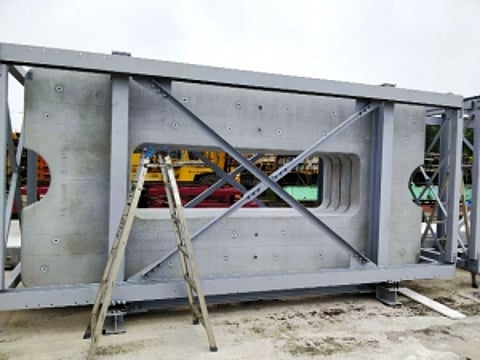

The groundwork for the ambitious bullet train project in India has gained momentum after Japan dispatched 20 units of tracks, each 50 metres, worth Rs 450 crore. The shipment is likely to be received by the National High Speed Rail Corporation limited (NHSRCl) by next month-end.
The modernised tracks, all manufactured by Japan Railways, will be first installed at the upcoming High Speed Railway Training Institute at Vadodara to train all those involved in the operations of the Mumbai-Ahmedabad Bullet Train project.
The training facility being developed at cost of Rs 600 crore is mandated to train a workforce of 3,500, including engineers, technicians, loco pilots, signalmen, maintenance staff and related stakeholders, from March 2019 with a batch of about 80 candidates until the first train is full operated.
“The tracks are the most crucial aspect in high speed train operations. They are under shipment from Japan and will be received in a month’s time.
They will be in all shapes that are straight, curvature, angles built with a state-of-the-art technology.
Tracks developed for bullet train in India will be a bit different and specialised to suit Indian weather conditions, viz the temperature which is more than that of Japan. We also have floods and more rain in the coasts, so it will be a maintenance-free like all other rolling stocks material which will meet the same standards,” said Anupam Awasthi, Deputy Chief Project Manager, NHSRCl.
Awasthi is the first Indian Railway officer who has undergone two years’ full-time training course in Japan for the purpose and subsequently, so far 40 officers have already received training from this advanced Rail Training and Research Institute, Japan.
“The officers and other related staff are being trained at RTRI so that they use their expertise and train the Indians who will be recruited at stages for the operations of the first bullet train in India,” Awasthi added.
The 508-km Mumbai-Ahmedabad Bullet Train is being funded by Japan International Co-operation Agency (JICA) and is scheduled to begin its operations by August 2022.
Sources, however, said that even if the entire stretch is not ready, focus will be to at least start operations between Surat and Mumbai. The earlier schedule of the corridor operations was 2023.
Besides the initial lot of tracks for training purpose, simulators worth Rs 50 crore will also be shipped from Japan for the training facility at Vadodara by the end of 2020.
While most of those involved in the development of the Japan-funded Rs 1 lakh crore bullet train have been drawn from the Indian Railways system, new recruits like pilots, signals and other manpower will be recruited by NHSRCl in due course. They will be trained by blend of expertise from both India and Japanese side.
“As mandated by Prime Minister Narendra Modi to commission the first bullet train on the occasion of Platinum Jubilee of India’s Independence, the first run will be done by Indian staff only,” asserted NHSRCl spokesman Dhananjay Kumar.