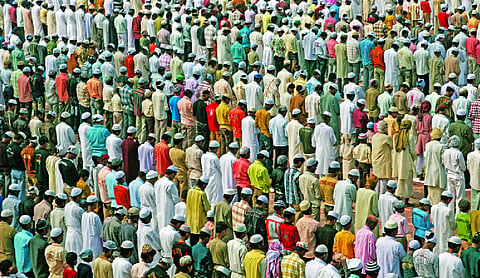

India is projected to have the world’s second-largest Muslim population by 2070, after Pakistan, while remaining a Hindu-majority country, according to a study by the Pew Research Centre (Pew) forecasting changes in global religious demographics over the next five decades.
The study projects that Hindus will account for 76 per cent of India’s population in 2070, down from 79 per cent in 2020. The share of Muslims is expected to rise from 15 per cent to 20 per cent over the same period.
India’s Hindu population is projected to increase from 1.11 billion (111 crore) in 2020 to 1.29 billion (129 crore) in 2070, a rise of around 176 million (17.6 crore). However, its share of the country’s overall population is expected to decline slightly, highlighting the distinction between absolute population growth and a community’s proportion of the total population.
Pew attributes the projected changes primarily to differences in age profiles and fertility rates. Indian Muslims are younger, on average, than Hindus and have higher fertility rates, factors that contribute to population growth over time.
In 2020, the median age of Muslims in India was 24, compared with 29 among Hindus. The study estimates that the average number of children per Hindu woman has declined to 1.9 from 3.3 three decades ago. Between 2025 and 2030, Muslim women in India are projected to have an average of 2.3 children, compared with 1.8 among Hindu women.
Despite the projected changes, Hindus are expected to remain India’s largest religious community, accounting for more than three-fourths of the population by 2070.
India is also projected to remain the country with the largest Hindu population. In 2020, it accounted for 94.5 per cent of the world’s Hindu population, estimated at 1.11 billion. By 2070, India’s Hindu population is projected to rise to 1.29 billion, although its share of the global Hindu population is expected to fall marginally to 93.6 per cent.
Globally, the Hindu population is projected to increase by 199 million between 2020 and 2070, while its share of the world’s population is expected to decline from 15 per cent to 14 per cent. Pakistan and the US are also projected to witness growth in their Hindu populations. Pakistan’s Hindu population is expected to nearly double from five million to 10.3 million, largely driven by natural population increase. The US is projected to have 7.4 million Hindus by 2070, with immigration cited as the main contributor.
The study also projects a major shift in the global religious landscape, with Muslims expected to overtake Christians as the world’s largest religious group by 2035. Pew estimates that the world had 2.27 billion Christians and 2.02 billion Muslims in 2020. By 2035, the Muslim population is projected to reach 2.57 billion, compared with 2.52 billion Christians.
Differences in fertility rates are among the factors driving the projected change. Muslim women had an average of 3.1 children during 2020-2025, compared with 2.5 among Christian women. Women belonging to other religious groups had an average of 1.6 children, below the replacement level of 2.1 children per woman.
Pakistan is projected to surpass Indonesia as the country with the largest Muslim population by 2070. Its Muslim population is expected to reach 461 million, accounting for 13 per cent of the global total. India is projected to rank second with 334 million Muslims, while Nigeria is expected to rise to third place.
In 2020, Indonesia had the world’s largest Muslim population at 239 million, followed by Pakistan at 227 million, India at 213 million, Bangladesh at 151 million and Nigeria at 120 million. By 2070, Nigeria is projected to become the third-largest Muslim-population country, while Ethiopia and Afghanistan are expected to enter the list of the world’s 10 largest Muslim populations.
The study projects that all 53 countries and territories that had Muslim-majority populations in 2020 will continue to have Muslim majorities in 2070. Muslims are expected to account for 90 per cent or more of the population in most of these countries. However, in 92 countries and territories, Muslims are projected to constitute less than five per cent of the population in 2070.
The projections also indicate differing trajectories among other religious groups. While Hindus and Jews are expected to grow in absolute numbers, their share of the global population is projected to decline. Buddhists are expected to decline in both population size and share, partly due to anticipated population decreases in China, South Korea, and Japan.
The Pew study covers 201 countries and territories, representing virtually the entire global population. It tracks seven religious groups between 2020 and 2070, using census and survey data to estimate population size and age profiles and factoring in fertility, mortality and religious switching, while assuming recent demographic trends continue.
The report is based on the figures and information supplied. The projections are presented as estimates conditional on demographic trends continuing, not as certainties.
