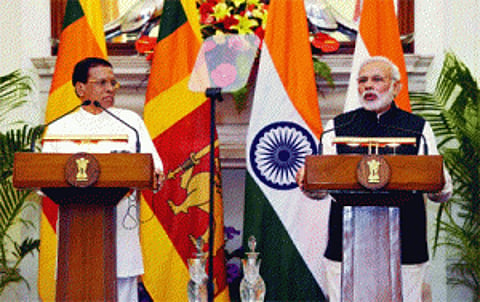

Sri lankan President Maithripala Sirisena’s maiden trip to India for a “new beginning” generated a lot of bonhomie, investment commitments and an agreement on civil nuclear energy, and steps to generate employment and push lankan economy. As a goodwill gesture, Prime Minister Narendra Modi also decided to reduce entry fee in National Museum for lankan nationals who visit the place to pay homage to their holy relic — Kapilvastu. Besides, lanka will now be part of the Nalanda University Project. Modi agreed to check the present trade imbalance which is heavily tilted in favour of India, and increase air and sea connectivity between the two nations in order to boost tourism in lanka. Co-operation in Defence, maritime security, agriculture and culture were some other takeaways for Sirisena.
It is expected that more announcements will be made when Modi visits lanka in March. On Monday, Sirisena invited Modi to lanka which the PM promptly accepted. “I am eagerly looking forward to visiting your beautiful country in March,” Modi said. The civil nuclear energy agreement was long awaited since Colombo had been dragging its feet to sign a pact with India after it voted against lanka at a UN Resolution in 2013. Even though India had abstained during the voting on another UN resolution in 2014 for a probe on war crime committed against lTTE during the closing stages of the conflict, lanka under former President Mahinda Rajapaksha was seen cosying up more to China and Pakistan.
But with Sirisena keen to make a fresh start with India, the pending agreement was signed that provides for various aspects of civil nuclear cooperation, including safety and training of professionals. “The bilateral agreement on civil nuclear cooperation is yet another demonstration of our mutual trust. This is the first such agreement Sri lanka has signed. It opens new avenues for cooperation, including in areas like agriculture and healthcare,” Modi said.
Under the Agreement on Cooperation in the Peaceful Uses of Nuclear Energy, India would facilitate lanka in transfer and exchange of knowledge and expertise, sharing resources, capacity building and training of personnel in peaceful uses of nuclear energy, including use of radioisotopes, nuclear safety, radiation safety, nuclear security, radioactive waste management and nuclear and radiological disaster mitigation and environmental protection.
While terming his visit as a “remarkable milestone” in India-lanka ties, Sirisena said his first visit to India has borne “very fruitful results” and helped bring the relationship to “greater height”. Referring to the long-pending civil nuclear agreement, Sirisena added that during talks with Modi, both sides came to “several good conclusions to strengthen ties and strengthen friendship.” He added friendship between the two countries will not only help build stronger relationship bilaterally “but in international forums India will support us and have more understanding between the two countries.”
In a recent move, lanka has sought postponing publication of a United Nations’ report on alleged war crimes during civil war. lanka has sought time to establish a new judicial mechanism to deal with the allegations of war crimes and expects India to back it. On the tricky fishermen issue, both leaders said they attach highest priority to it. “It affects livelihoods on both sides. We agreed that there must be a constructive and humanitarian approach to the issue. We will encourage the fishermen’s associations on both sides to meet again soon. They should find a solution that can be taken forward by both Governments,” Modi said.
India and lanka also discussed expansion of cooperation in energy sector, both conventional and renewable. The PM announced that the Commerce Secretaries of both sides will meet soon to review bilateral commercial relations. The two leaders expressed satisfaction with the progress of India assisted projects for internally displaced persons in lanka. This includes the Housing Project, under which more than 27,000 houses have already been constructed.