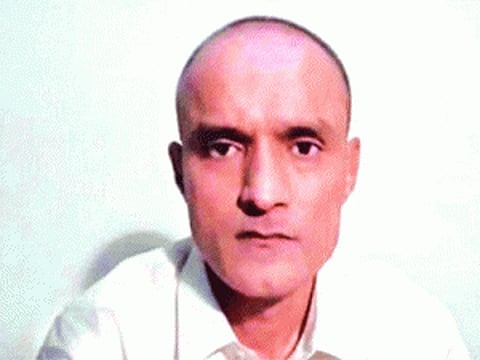

India and Pakistan on Monday sparred in the International Court of Justice (ICJ) over the death sentence awarded to ex-Indian Navy Commander Kulbhushan Jadhav with New Delhi seeking annulment of the death sentence of Jadhav as an immediate relief.
During his forceful submission before the ICJ in Hague, India’s counsel Harish Salve listed out several procedural lapses made by Pakistan under the Vienna Convention on Consular Relations (VCCR), 1963 adding it amounted to human rights violation.
Pakistan, however, rejected India’s allegation and said the ICJ has no jurisdiction over Jadhav’s case as it was linked to an act of terrorism.
Significantly, the ICJ refused to see a six-minute video clip of ‘confessional’ statement’ by Jadhav that Pakistan wanted to use as a proof to bolster its arguments on Jadhav being an Indian spy. The 11-Bench court, of which an Indian judge is also a member, will now pronounce its order in a day or two.
Jadhav was arrested on March 3, 2016, and sentenced to death by a Pakistani military court on charges of espionage and subversive activities. While forcefully putting forth his argument, counsel for India Harish Salve said Pakistan denied 16 requests for counsel access. Salve also said Pakistan did not even provide copies of chargesheet and military court’s verdict to enable India to appeal against his death sentence.
Terming it a major violation of human rights, Salve added that Pakistan blocked India’s efforts to provide legal aid to the former Naval officer and alleged he was in Pakistan’s custody without any communication to his family. As an immediate relief, India demanded suspension of Jadhav’s death sentence, expressing fears that Pakistan could execute him even before the hearing at the ICJ was over.
“The execution of the death sentence cannot be done while this court is hearing the appeal. Else, it will be a violation of the Vienna Convention,” Salve said. The urgent hearing comes after the ICJ last week stayed Jadhav’s execution,” Save argued.
The ICJ on Monday began a public hearing in the case of Jadhav with India arguing for an immediate suspension of the death sentence. The ICJ is hearing the issue of jurisdiction of the world’s top court in the matter of what India says violation of VCCR while Pakistan argued that it does not accept the jurisdiction of the top court in this matter.
“The procedural safeguards are greater when the charges are as serious as capital punishment. The Vienna Convention offers no exception. India asserts that the breach of the Vienna Convention is fatal. Under Article 36, jurisdiction exists in respect of all cases that parties refer to and in respect of all matters specially provided for in treaties and conventions,” Salve told the ICJ in a forceful submission. He argued that human rights treated as “basics” all over had been thrown to the wind by Pakistan and all requests for consular access to Jadhav had fallen on “deaf ears”.
Battling Pakistan in the UN’s highest judicial body, India said the situation was grave and urgent, prompting it to approach the court at a short notice. “Jadhav has not got the right to get proper legal assistance and the right to consular access. There is an immediate threat to him to be executed even before a decision is passed,” joint secretary in the Ministry of External Affairs Deepak Mittal (who was India’s agent at ICJ) told the court in opening remarks.
Pakistan, on its part, challenged India’s argument on the jurisdiction of the ICJ in the matter where the accused is accused of serious charges of espionage and terrorism. Pak’s agent Dr. Mohammad Faisal, who is Director General of South Asia and SAARC, played the terror card saying his country has been a victim of terrorism while accusing Jadhav to be an Indian spy out there to carry out more terror strikes in Pak.
Both Faisal, and counsel for Pak Khawar Qureshi, argued that the VCCR was not applicable in Jadhav’s case and it had limited jurisdiction. They accused India of using ICJ as a stage for political theatre. Pak showed a copy of Jadhav’s passport to the court as a proof of him being Indian spy, but interestingly, Qureshi went on to argue that while India had said Jadhav was an Indian citizen it has given no document to prove that.
India, in its appeal to the ICJ, asserted that Jadhav was kidnapped from Iran where he was involved in business activities after retiring from the Indian Navy. Salve said in order to ascertain any accusation on him, it was important for India to have access to the accused to whom Pak never allowed the Indian government to meet. Salve argued the rights of Article 36 of the Vienna Convention on Consular Relations are sacrosanct and cited that the International Covenant on Civil and Political Rights (ICCPR) recognises that no one can be arbitrarily deprived of their lives. He added India had not been given the copy of the charges filed against Jadhav. “The need for a wholesome compliance is greater when charges are serious. We want appropriate legal representation for Kulbhushan Jadhav,” Salve said.