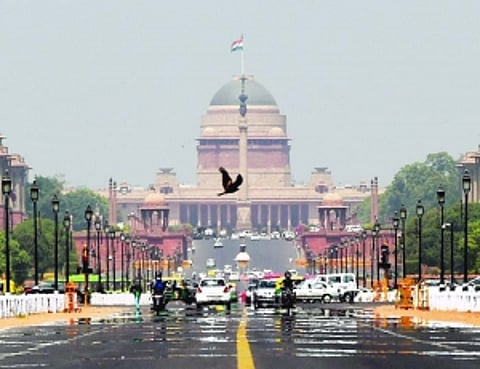

Palodhi in Rajasthan records 50.5 degrees Celsius; south India reels under heavy rain
Extreme weather conditions in north and south India saw people dying both due to the heat and due to heavy rains on Wednesday and things are expected to get worse on both ends in the next few days.
The maximum temperature in India touched 50.5 degrees Celsius in Palodhi (Rajasthan) and 50 degrees Celsius in Ahmedabad followed by 49.1 at Churu, 48.8 at Jaisalmer and 48.6 degrees at Barmer. Delhi and several parts of north, north-west and central India were also reeling in the blistering heat, prompting the weather department to issue a “severe heatwave” warning for the next five days.
“Heatwave conditions continued to prevail at most places with severe heatwave at a few places over East and West Rajasthan, Madhya Pradesh, Gujarat, Vidarbha, Haryana and Delhi, East Uttar Pradesh and central Maharashtra,” the India Meteorological Department (IMD) said.
According to the IMD, the heat will remain bad till May 21 and its intensity is likely to reduce thereafter and gradually abate anywhere between May 27 and 31. The Met department has predicted that the onset of monsoon will get delayed by six days.
“Maximum day and minimum night temperatures are likely to remain markedly above normal over the entire North-West, West and Central India from May 17 to 27. They are likely to fall to their respective normal or below normal values between May 27 and June 1,” the IMD said.
According to private weather watch group Skymet, Gujarat and Rajasthan will witness scorching weather with day temperatures reaching the higher side of 40s in places like Jaisalmer, Phalodi and Barmer. Clear skies, hot and dry winds coming from the North and North-West direction will sustain such high temperatures.
In Gujarat, four people lost their lives due to the severe heatwave as mercury levels across many parts of the State rose to near about 47 degrees Celsius. The State has witnessed over 11,400 heatstroke cases due to the severe heat that gripped the State from May 1 to May 16 this year. “We do not see any respite in temperature across the State of Gujarat,” Jayant Sarkar, Met Department, Ahmedabad division, said.
While northern India burns, heavy rain has lashed south India and the Government has issued a cyclone alert in Andhra Pradesh and Odisha. Several parts of Tamil Nadu and Puducherry continued to receive rainfall for the third day due to a depression but it is likely rainfall will decrease in the coming days as the deep depression over the Bay of Bengal has moved toward Andhra where a cyclonic storm is expected to intensify from Thursday onwards. The IMD has advised fishermen against venturing along and off north Tamil Nadu and coastal Andhra Pradesh.
Weather conditions are going to be better in the coming days in eastern India with predictions of a thunderstorm accompanied by a squall at isolated places over Bihar, Jharkhand, West Bengal, Sikkim and Odisha.
Meanwhile, ten people were killed in landslides triggered by torrential rains in Assam while one died of heatstroke in Odisha.
In Uttar Pradesh temperatures remained above normal in most places but thundershowers are predicted for Thursday in the eastern parts of the State. Uttar Pradesh too witnessed heatwave conditions at some places, with Banda being the hottest at 47 degrees Celsius.
As many as 309 heat-related deaths have been reported in Telangana since the beginning of summer this year. However, light to moderate rain /thundershowers are likely to occur at isolated places over Telangana. The highest temperature of 44 degrees Celsius was recorded at Adilabad.
Extreme heat is drying up water stocks in 91 major reservoirs in India which has decreased to 29.46 Billion Cubic Meters (BCM) from the previous week’s level of 30.71 BCM. Current storage is lower than last year’s position of 48.29 BCM and the average of last 10 years’ storage of 37.09 BCM. There are 24 reservoirs with storage between 30 per cent to 50 per cent, 20 reservoirs having storage up to 30 per cent of normal storage and seven reservoirs with no live storage.