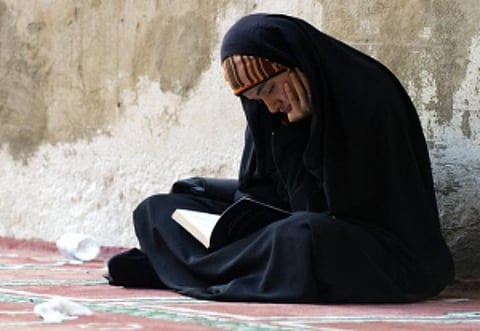

Muslim organisations on Wednesday argued in the Supreme Court that triple talaq was optional for women giving the Centre a chance to claim that an “optional” practice cannot be fundamental part of a religion and hence must be scrapped as unconstitutional.
The submission followed a statement by the Jamiat Ulema-e-Hind, Maharashtra that Muslim women marrying under the Special Marriages Act 1954 will not have to comply with talaq provisions contained in the Muslim personal laws.
The All India Muslim Personal law Board (AIMPlB) said triple talaq is a “dying practice” pointing to data collected by a recent online survey showing that out of 331 divorces reported among Muslims, only one reported instance of oral triple talaq.
The Constitution Bench headed by CJI JS Khehar, all set to conclude hearing on arguments on Thursday, asked AIMPlB counsel and senior advocate Kapil Sibal, “Can it be that the AIMPlB passes a resolution binding all Quazis to incorporate a condition in the nikaahnama which gives the woman option to say no to triple talaq before she gives her consent to marry.”
Sibal said the ground reality is changing as he showed a resolution issued by the Board on April 14, 2017 educating people about discouraging triple talaq. He said, “In the absence of firm data, when the courts suo moto raise a dying practice as a constitutional issue, it sends a wrong impression. An impression builds up that if the door of personal laws is opened to you (Court), the door is ajar for anyone to enter.” But the CJI had an effective counter. He said, “In your Friday prayers said every week at the mosque, you recite that biddat (triple talaq) is sin. While your scripture records other two forms of talaq, it does not talk of biddat.”
The argument by Muslim bodies came handy for the Centre. Attorney General Mukul Rohatgi told the Bench, “They talk about triple talaq existing for 1,400 years. Now they suggest that women can strike it off in the nikaahnama. Even without triple talaq, the religion will remain the same. Even their scripture suggests such practice to be undesirable. So what is made optional or undesirable, how can it be an essential part of religion or even a religious practice.”
Even otherwise, the A-G argued this is not a case of “majority versus minority” as Government will preserve interests of all religions. Distinguishing the present case being violation of fundamental rights of women in a particular community, Rohatgi said, “A secular Constitution must rise above religious interests. Your right to religion must give way if not in accord with Fundamental Rights.”
Senior advocate Indira Jaising, advocating against triple talaq, said, “Since Constitution came into existence in 1950, equality before law is a protected right and Sharia law clearly discriminates between men and women.”
The Bench also comprising Justices Kurian Joseph, Rohington F Nariman, UU lalit and S Abdul Nazeer observed that judicial precedents abounded where courts refused to decide on such issues, leaving it open for the legislature to decide. Similarly, it noted that discriminatory practices within Hindu religion — untouchability, sati, widow remarriage, etc., were removed by Parliamentary laws. Jaising urged the Court not to maintain a “hands off” approach in the name of saving personal laws under Article 25. If it does so, the court will be seen as “cancelling” out the Constitutional guarantee of equality under Articles 14 and 15, she added.