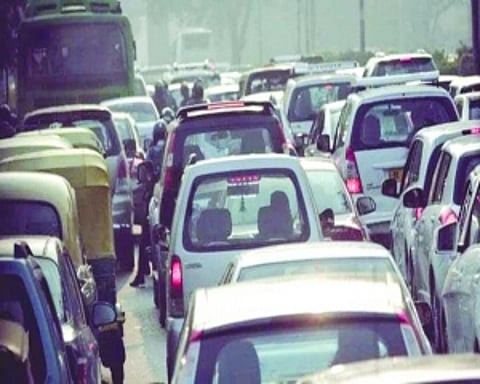

Parliament on Wednesday approved the Motor Vehicles (Amendment) Bill 2019 that aims to infuse more discipline on roads by tightening rules and increasing penalties. The Bill passed in the Rajya Sabha envisages a sea change in how Indian roads and vehicular transportation are governed.
After the amendment, minimum penalty for violation of traffic rules goes up from Rs 100 to Rs 500. The maximum penalty has been fixed at Rs 10,000. As a novel step, the Motor Vehicles (Amendment) Bill provides for community service as punishment to violators of road safety rules and regulations.
The Bill moved by Road Transport Minister Nitin Gadkari was passed in the Rajya Sabha after a long discussion with a voice vote. The Bill will amend the provisions of the Motor Vehicles Act of 1988. The Lok Sabha first passed the amendment Bill first in 2017, but it was not cleared in the Upper House and eventually lapsed with the dissolution of the 16th Lok Sabha.
As per the new motor vehicles law, in case of driving a vehicle without holding a licence, the penalty has been increased from Rs 500 to Rs 5,000. Not wearing a seat belt will invite a penalty of Rs 1,000. It was Rs 100 only till now.
For drunken driving cases, the penalty is Rs 10,000 — up from Rs 2,000 under the existing law. For dangerous driving, the penalty is Rs 5,000. Not giving pass to emergency vehicles will attract Rs 10,000 penalty. There was no such provision under the previous law.
In cases of over-speeding, the driver will be penalised Rs 1,000 for light motor vehicles such as cars and Rs 2,000 for heavier vehicles. If found engaged in racing, the driver will have to pay a penalty of Rs 5,000.
The new motor vehicle law provides for regulation of taxi aggregators such as Uber and Ola. They will now have to get licence from the Governments of the States they operate and also conform to the Information Technology Act of 2000.
A national road safety board will be created to advise the Central and State Governments on all aspects of road safety and traffic management.
If your vehicle’s insurance coverage has expired and you are still driving it, you will be penalised Rs 2,000 and penalties may be increased by 10 per cent every year - keeping pace with your annual increment.
Further keeping in mind that not all road accidents happen due to negligence of the driver but many other factors the new motor vehicle Bill seeks to fix liability of contractors for faulty road designs.
If juveniles are found to be driving a vehicle and cause an accident, the guardian or the owner of the vehicle will be held liable and prosecuted accordingly. The new law also talks about “Good Samaritans” defining them as a person who comes forward to help a road accident victim. This is likely to encourage people to help a victim of road accidents.
Putting the road safety priority in his Bill, Road Transport Minister Nitin Gadkari said that maximum road accidents in the world occur in India, thus road safety has been given priority in the Bill to curb the number of road accidents. Urging the members to pass the Bill, the Minister said it has been “pending for long” and that it is not a “political subject”.
Gadkari noted that annually about five lakh road accidents take place in the country, in which there are 1.5 lakh deaths and 65 per cent of them are youth. Since 40 per cent road accidents take place on highways, the Government has decided to identify the “blackspots” for which Rs 14,000 crore will be spent. The Government has submitted a proposal to the ADB Bank seeking funds for the project, he added.
Congress alleged that the Centre has “hoodwinked” Rajya Sabha on the Motor Vehicles (Amendment) Bill as it was “defective” and not in the form passed in the Lok Sabha last week, a charge rejected by the Government.