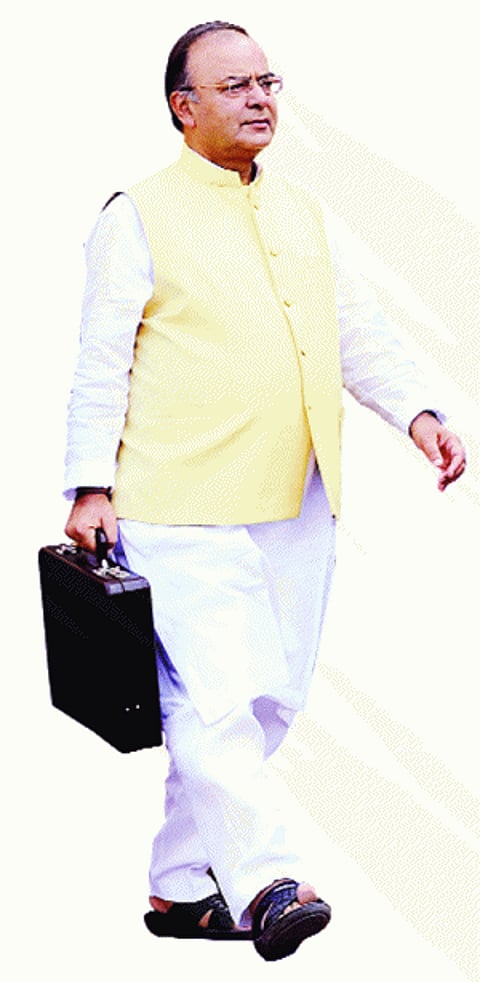

Fiscal deficit stabilised, Jaitley charts growth path; FDI, PPP new mantras for resource mobilisation; agro-industries set to benefit farmers
Keeping aside populist overtures, the maiden Budget of the Modi Government took a balanced approach for sustained growth and addressed a wide array of issues flagged in NDA’s manifesto. It kept in mind the compulsions of expenditure control to curb the fiscal deficit, while planning to rejig the record low growth inherited from UPA.
The first Budget of Finance Minister Arun Jaitley has targetted to reduce fiscal deficit to 3 per cent of the GDP by 2017, even as it desisted from splurging in any big-ticket largesse. It clearly emphasised on ‘Modinomics’ while reworking UPA’s many aberrations, including retro-taxation and recasting UPA’s politically motivated social schemes like MNREGA and NRHM, which failed to deliver.
Keeping up the promises made by the BJP during the lok Sabha elections, Jaitley has proposed 100 smart cities in the country, cleaning Ganga, creating a digital India, new waterways, airports in tier I and II cities as well as in metros like lucknow and Ahmedabad. He has focused on promotion of tourism in a big way by developing infrastructure in both rural and urban areas particularly through ‘Swatchh Bharat Abhiyan’ by 2019.
The hike in IT exemptions is expected to cut the revenues of the national exchequer by Rs 22,000. On the indirect taxes, the FM has made cheaper lCD, lED TVs, footwear, as well as computers, while he made costlier cigarette and tobacco products.
Expressing concern for the common man, the Budget prioritises farm sector growth particularly in the wake of high food prices that has relentlessly dogged the common man since the UPA tenure. With this, the Government would be restructuring Food Corporation of India and Public Distribution System to make it more delivery oriented. The Budget also indicated its preparedness for implementing the GST and the Direct Tax Code (which has now lapsed). The FM said that “the Government would take review of whole matter” from stakeholders.
Aiming at spurring growth, the Budget calls for kick-starting FDI in defence and insurance by raising the FDI limit to 49 per cent; fast-racking growth of highways; refining the fuel, food and fertiliser subsidisation by making it ‘more targeted’ and has raised the subsidy bill by 2.5 per cent to Rs 2,51,397.25 crore. The Budget enhances bank capitalisation with an estimate of Rs 2,43,000 crore in current fiscal even as Jailtey emphasised that Government holding in PSBs will be diluted and retail investors would be able to ‘directly’ own bank’s shares.
Jailtey has pushed for simplification of doing business in India under a more “friendly and liberal” tax regime. Special emphasis has been given on developing infrastructure sector including highways, airports, ports, SEZs and housing sector --- wherein the government would set up ‘3P India’ with an initial corpus of Rs 500 crore to help promote funding PPP projects. The FM has emphasised on promoting low-cost housing and has allocated Rs 7,060 crore.
The Finance Minister said that he accepts the long-pending demand from the industry and the capital markets regulator SEBI for giving tax incentives for REITs as well as Infrastructure Investment Trusts which has helped in mobilising long-term funds from both domestic as well as offshore investors.