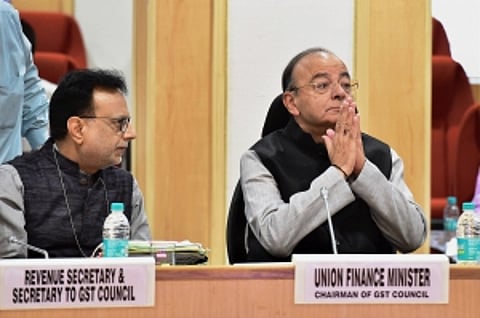

Ahead of Diwali, traders and consumers have reason to cheer as the Goods and Services Tax (GST) Council on Friday announced a slew of reforms, reducing tax on many goods and services and relaxing norms for small businesses.
In a move aimed at providing relief to traders and exporters; bringing simplicity and cutting compliance costs, the GST Council also decided to raise the turnover threshold to Rs 1 crore from Rs 75 lakh for businesses to avail of the composition scheme that allows them to pay 1-5 per cent tax without going through tedious formalities.
For businesses with a turnover up to Rs 1.5 crore, the council permitted filing of quarterly returns as against the monthly filings mandatory earlier.
The move comes at a time when the Government is facing criticism that the economy is reeling under the adverse impact of GST on businesses.
Even after three months of implementation of GST, the issue of complexity of compliance and high tax on certain daily-use items and services was drawing huge criticism.
Finance Minister Arun Jaitley, who headed the 22nd GST Council meeting, cheered the taxpayers by announcing that returns for the month of July and August would be refunded through cheques from October 10 and October 18 respectively. “Moreover, an e-wallet will be created for each exporter by April 1, 2018 to carry forward the process,” he added.
Jaitley, however, said, “For small traders the tax burden is low, but the compliance pressure is greater. Members examined the provisions and after detailed study we found that large companies/taxpayers contribute to 94-97 per cent of the taxes filed. Medium and small taxpayers need to be in the tax net so that the tax base keeps increasing, but their compliance burden should be reduced.”
“So far, over 15 lakh out of the 90 lakh registered businesses have opted for the composition scheme,” he added.
Bringing forth some more reforms, the Government has said that any person buying jewellery above Rs 50,000 will not have to furnish PAN card and Aadhaar card details.
The GST Council also reduced rates for as many as 27 commonly-used items and services. Branded savoury snacks, unbranded ayurvedic medicines, handmade yarn, ICDS food packages, khakra chapati, waste obtained from rubber, plastic and paper have been brought under the 5 per cent slab.
Among services, zari work, making imitation jewellery and printing items have also been brought under this slab.
Jaitley further said, “The GST Council has agreed to allow SMEs with turnover of up to Rs 1.5 crore to file quarterly returns instead of monthly filings. About 90 per cent of the taxpayers will benefit from this change.” “The rollout of E-Way Bill, another issue that has been under consideration for a long time, has been deferred to March 31, 2018,” he added.
For manufacturers and restaurants, Jaitley said traders would pay 1 per cent, 2 per cent and 5 per cent respectively under the composition scheme.
The scheme allows small businesses, including eateries, to pay 1-5 per cent tax without having to deal with the three-stage filing process.
However, as far as the composition scheme is concerned, service providers cannot opt for it, other than restaurant related services; manufacturer of ice cream, pan masala, or tobacco; casual taxable person or a non- resident taxable person; and businesses which supply goods through an e-commerce operator.
No input tax credit can be claimed by those opting for composition scheme. Also, the taxpayer can only make intra-State supply of goods.
Besides, the GST Council also decided that entities dealing in gems, jewellery and other high value goods, having an annual turnover of over Rs 2 crore, will no longer be under the purview of the Money laundering Act. Revoking the GST notification on gems and jewellery, the Government said a separate notification in this regard would be issued later.