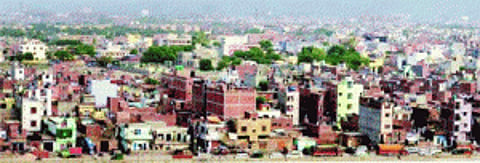

Seven years since the contentious move of regularising over 1,600 unauthorised colonies was first set into motion, it turns out as many as 486 colonies are not even eligible for regularisation while the fate of 326 others hangs in a balance as they fall under the jurisdiction of multiple agencies like Department of Forests, Delhi Development Authority (DDA) and Archaeological Survey of India (ASI).
With Assembly polls in Delhi likely to be held early next year and the Narendra Modi Government pushing for finalising the regularisation process, the Delhi Government has informed that only 92 colonies of the 904 pending are “presently” eligible for regularisation. However, regularising even these will be a difficult proposition.
The Delhi Government has suggested one overarching Act to replace the existing framework of regulations to overcome hurdles in acquisition proceedings, restrictive applicability of Delhi land Reforms Act in unauthorised colonies, declaration of nature of land, applicability of Panchayati Raj Act, relaxation of building bylaws and Master Plan of Delhi-2021, among others.
Sources in the Ministry of Urban Development told The Pioneer that Delhi Government has sent a confidential note, suggesting the tricky issue of regularisation of unauthorised colonies, which is considered a major votebank for political parties in the national Capital.
“Forest land and ASI affected colonies may be dealt with as per the existing laws, declaring them liable to be demolished within a year after boundary of the unauthorised colonies being fixed and land to be declared as urbanised and title of land be conferred to occupants after determining gaon sabha land as private as per the definition,” it said. According to a note, the Government will have to be shown any changes in the guidelines to the High Court.
According to the note, the Delhi Government is finding it difficult to regularise unauthorised colonies due to the impracticality of 2007 guidelines since vacant land is not being made available by RWAs even though they promised it via affidavit, categorisation of developed and undeveloped land, overlapping of boundaries and boundary fixation discrepancies, no provision of ground verification, cost of Government land recovery mechanism not settled, built-up plots or built-up area of these colonies and issue of less built-up percentage (below 50 per cent).
Officials say that the Delhi Government has asked to simplify the norms of 2007 regulation that include remove or change built-up percentage as on 8.2.2007; colonies be declared regularised within the boundary fixed and structures building/plots therein be regularised later with the scheme of incentives and disincentives; relaxation of Master Plan for Delhi 2021 and building bylaws wherever necessary; land use change by DDA wherever necessary; cost of Government land be made incremental in nature as larger parcels of land should fetch the Government higher per unit cost; development charges and penalty of regularisation be defined and mode of recovery be provisioned; boundary of the unauthorised colonies be determined through physical inspection and ground verification and total station method survey.
Similarly, Government and forest land, DDA hindrances and ASI affected patches of land within the unauthorised colonies be determined while fixing boundaries. Delinking of development work and regularisation process; Government and private land be defined unambiguously, title of land is conferred on the basis of actual possession and prescribed set of documents and if no building plan and title are confirmed within a year of declaration of colony regularisation with fixed layout plan than double the water and electricity charges in those building for first year and three times thereafter as disincentive.
In 2007, the Government placed the guidelines before the court. In 2008, it resumed its call for applications from unauthorised colonies seeking regularisation. The Resident Welfare Associations of these unauthorised colonies had to submit various documents such as land details, certificates, layout plans and undertakings to abide by the approved layout plans and provide land for social infrastructure. It received applications from 1,639 colonies out of which 985 colonies were finalised for regularisation as per norms. The rest 904 colonies are under process for regularisation. Out of the 904 colonies, only 92 colonies are eligible for regularization; 486 are not eligible for regularisation and 326 colonies are sill indeterminate due to the non-availability of built-up percentage as per guidelines and forest, ASI and DDA hindrances within the unauthorised colonies.
In September 2012, the Government issued an order finding 895 unauthorised colonies “eligible for regularisation”. The order specified that these were selected based on two conditions: they did not lie on “forest and ridge areas and protected area” and did not hinder the “provision of infrastructural facilities under the Master Plan-2021”. In spite of the order, Government and media reports have treated the colonies listed in the 895 unauthorised colonies order as de facto regularised. However, a closer look at this order reveals that only 312 of the colonies - those located on private land- stoodregularised at the time of the order.