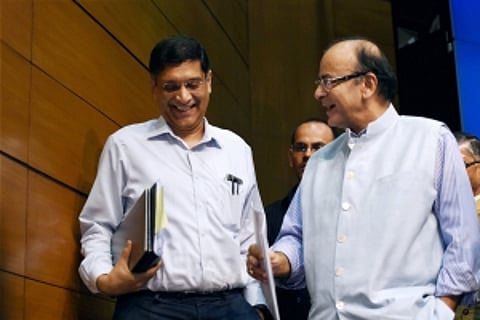

Assuring a smooth rollout of Goods and Services Tax (GST) in the country as “one nation, one tax”, the Government on Thursday showcased a detailed road map for the implementation of the GST from April 1, 2017, a target considered ambitious. To this effect, the Centre will ensure the Bill is ratified by at least 50 per cent of the States i.e. 15 Assemblies, in next one month. The next task is to set up GST Council and table the Central GST and the integrated GST laws in the Winter Session of Parliament. The complete road map was announced by Revenue Secretary Hasmukh Adhia, who spoke to the media about the proposed step-by-step actions.
While Finance Minister Arun Jaitley said the tax rate would be “optimum”, there are indications that it may be higher than 18 per cent. The tax rate will be decided by the GST Council, which will have Union Finance Minister and representatives of all 29 States as members. “We are going to try to make it reasonable as soon as possible. It is always good to set stiff targets and try to meet the same, rather than have no targets at all,” Jaitley said.
However, the Revenue Secretary said, “The Government is expecting that a complete notification of GST rules may be available by March 31, 2017 and the passage of CGST and IGST laws could happen in the upcoming Winter Session,” he said.
On the GST rates, Adhia said it would be premature to expect the GST’s standard rate to be 18 per cent, saying it would imply significant revenue losses.
Central excise duty and State VAT taken together added up to 27 per cent currently.
“I think what you need is an optimum rate. Currently what the tax payers are paying is phenomenally much higher. Now it will gradually slide down. But even in the first instance it will come down,” Jaitley added.
“We are hopeful that the GST software will be ready by December 2016, after which testing, integration of GST software will happen from January-March next year,” Adhia said, adding that training of 60,000 State as well Central Government officials will be over by December, and GST laws and IT infrastructure framework by March next year.
He added there are challenges ahead for the Government such as calculation of revenue base of the Centre and the States, and compensation requirements, structure of GST rates, list of exemptions, forming of consensus on Model GST Bill, threshold limits, compounding limits and cross empowerment to mitigate ill-effects of dual control.
“We have set a deadline for stakeholder consultation to be completed by March 2017, and thereafter VAT/Service tax/Central Excise will be migrated to GST system thereafter. I think the GST rate structure should be such that it should not be obnoxious, which would meet the revenue requirement of State and Centre,” Adhia said.