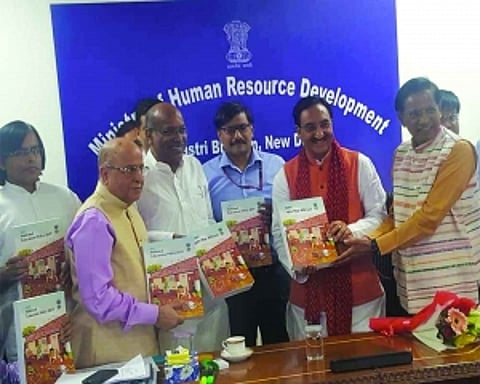

Amid the uproar over the draft version of the National Education Policy (NEP) 2019, which mandated compulsory learning of Hindi in non-Hindi-speaking southern States, the Ministry of Human Resource Development (MHRD) on Monday released a revised version of the policy giving the students freedom to choose any language they wish to study under the three language model in schools.
The revised draft policy states, “In keeping with the principle of flexibility, students who wish to change one or more of the three languages they are studying may do so in Grade 6 or Grade 7, so long as they are able to still demonstrate proficiency in three languages (one language at the literature level) in their modular board examinations some time during secondary school.”
There is no mention of Hindi in the “Flexibility in the three-language formula” clause. The revised policy requires proficiency in any three languages. The revised draft reads, “Since the modular board examinations for language proficiency will indeed test only the basic proficiency in each language, such change in choice in Grade 6 would certainly be feasible if the student so desires and would in such cases be supported by teachers and the schooling system.”
The revision to the draft comes after many politicians and citizens slammed the Centre for imposing Hindi, in an alleged attempt to “homogenize” the diverse linguistic fabric of the country, which has many regional languages, especially down south where they have a prominent presence as a part of the Dravidian identity.
The earlier draft education policy triggered outrage in southern States, led by Tamil Nadu, which said they will not tolerate Hindi imposition in the State that doesn’t speak the language. The DMK and other parties in Tamil Nadu, which had strongly opposed the proposal in the 484-page draft National Education Policy(NEP) to make Hindi a mandatory third language to be taught in schools across the country, welcomed the Centre’s decision. Oscar-winning composer AR Rahman welcomed the Centre’s decision. “Draft(NEP) policy corrected. Beautiful solution,” he tweeted.
Tamil Nadu had always resisted the “imposition” of Hindi. In 1965, the State witnessed violent protests against a proposal that Hindi would be India’s only official language.
The DMK on Monday said the Centre’s decision showed that late party patriarch M Karunanidhi was “living,” apparently suggesting that it was a success to his legacy of opposing “imposition” of Hindi. After presiding over a meet of his party district secretaries, MPs, and MLAs, DMK president MK Stalin said in a tweet: “At a time when we are celebrating the birth anniversary of Thalaivar (leader) Kalaignar (late Karunanidhi), the Central Government withdrawing the Hindi compulsory subject clause shows that Kalaignar is living.” “Let us guard mother Tamil always breaking up the hegemonic imposition of Hindi,” he said.
The earlier draft read, “…the study of three languages by students in the Hindi-speaking States would continue to include Hindi and English and one of the modern languages from other parts of India, while the study of languages by students in non-Hindi speaking States would include the regional language, Hindi and English.”
After the protest over imposition of Hindi in non-Hindi speaking States, the MHRD last week has issued a clarification. “This is a draft policy submitted by the committee and is placed for views of general public. It is not the policy announced by the Government,” reads the draft.
On May 31, former ISRO Chairman K Kasturirangan, Chairman of the Committee for Draft National Education Policy, with other members submitted the report to the newly appointed HRD Minister Ramesh Pokhriyal Nishank soon after he took charge.