
Q1 growth rate sinks to 5%; 10 banks amalgamated into 4 PSBs
The faltering Indian economy plunged to a seven-year-low in terms of GDP growth rate which has come down to 5 per cent for the April-June quarter of 2019-20. The GDP figure was announced soon after Finance Minister Nirmala Sitharaman announced mega merger of public sector banks to arrest the growth deceleration.
Both the announcement may have been prescheduled, but the fact remains that in the know of the GDP calculations, the Government has swung into action and announced a series of measures to deal with the alarming decline in the economy.
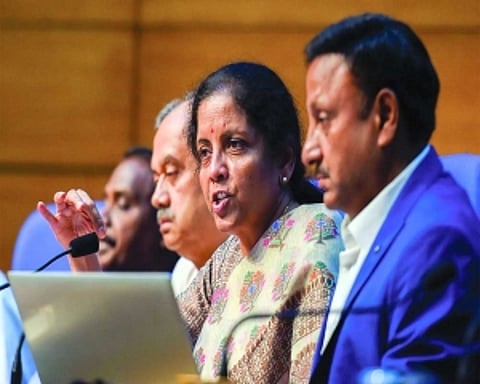
Sitharaman, who had last week announced tax sops and measures for sectors such as auto, announced merger of ten banks into four new sets of banks — Punjab National Bank, Oriental Bank of Commerce and United Bank of India will combine to form the nation’s second-largest lender; Canara Bank and Syndicate Bank will merge; Union Bank of India will amalgamate with Andhra Bank and Corporation Bank; and Indian Bank will merge with Allahabad Bank.
The GDP collapsed due to a sharp fall in the manufacturing sector and sluggish agriculture output, according to official data released on Friday. The previous low was recorded at 4.9 per cent in April-June 2012-13.
The gross value added (GVA) growth in the manufacturing sector tumbled to 0.6 per cent in the first quarter of this fiscal from 12.1 per cent expansion a year ago. Similarly, farm sector GVA growth remained subdued at 2 per cent as compared to 5.1 per cent in the corresponding period of the previous fiscal.
Construction sector GVA growth too slowed to 5.7 per cent from 9.6 per cent earlier. However, mining sector growth climbed to 2.7 per cent from 0.4 per cent a year ago.
“GDP at Constant (2011-12) Prices in Q1 of 2019-20 is estimated at Rs 35.85 lakh crore, as against Rs 34.14 lakh crore in Q1 of 2018-19, showing a growth rate of 5 per cent,” the National Statistical Office (NSO) said in a statement.
Gross Fixed Capital Formation (GFCF), which is a barometer of investment, at constant (2011-12) prices was estimated at Rs 11.66 lakh crore in the first quarter as against Rs 11.21 lakh crore a year ago.
The decline in the growth was by and large anticipated but few had expected such sharp collapse in the economy. Several foreign rating agencies have already cut India’s growth forecast and pegged it below 7 per cent for the ongoing fiscal.
China, which is in the midst of an intense trade war with the US, has done far better than India despite the adverse economic climate. China’s economic growth was 6.2 per cent in April-June quarter of 2019, which was the weakest expansion in 27 years. It is obvious that the “dragon” remains way ahead of India.
The RBI had marginally lowered the GDP growth projection for 2019-20 to 6.9 per cent from 7 per cent projected earlier in the June policy, and underlined the need for addressing growth concerns by boosting aggregate demand.
“Real GDP growth for 2019-20 is revised downwards from 7 per cent in the June policy to 6.9 per cent — in the range of 5.8-6.6 per cent for first half of 2019-20 and 7.3-7.5 per cent for the second half — with risks somewhat tilted to the downside,” RBI had said in the monetary policy statement.
The continuous fall in the GDP shows that the country has still not recovered from the disastrous fallout of the demonetisation which sucked out liquidity from the system and slowed down consumption in various sectors. The hasty implementation of the GST, which had to be tinkered with several times since its inception, is also seen as a major culprit for pulling down the GDP.
The falling economy has led to flight of foreign investment from the country and weakening of Rupee. Post-Budget, the stock market has seen major correction and the foreign institutional investors continued to dump shares despite the Government announcing a series of steps to placate them.
Beset with such grim scenario, the Government on Friday unveiled a mega plan to merge 10 public sector banks into four as part of plans to create fewer and stronger global-sized lenders as it looks to boost economic growth from a five-year low.
The bank merger exercise, seen together with the previous two rounds of bank consolidation, will bring down the number of nationalised public sector banks to 12 from 27 in 2017. This, the Government feels, will make bank balance sheet stronger with greater capacity to lend.
Oriental Bank of Commerce and United Bank merger will merge into Punjab National Bank to create a bank with Rs 17.95 lakh crore business and 11,437 branches, Sitharaman told a news conference here.
The merger of Syndicate Bank with Canara Bank will create the fourth largest public sector bank with Rs 15.20 lakh crore business and a branch network of 10,324. Andhra Bank and Corporation Bank’s merger with Union Bank of India will create India’s fifth largest public sector bank with Rs 14.59 lakh crore business and 9,609 branches.
The merger of Allahabad Bank with Indian Bank will create the seventh largest public sector bank with Rs 8.08 lakh crore business with strong branch networks in the south, north and east of the country, she said, adding that Bank of India and Central Bank of India will continue to operate as before.
Last year, the Government had merged Dena Bank and Vijaya Bank with Bank of Baroda, creating the third-largest bank by loans in the country. After the mergers, the country will have 12 public sector banks, including State Bank of India and Bank of Baroda. Also, Indian Overseas Bank, Uco Bank, Bank of Maharashtra and Punjab and Sind Bank, which have strong regional focus, will continue as separate entities.
The Finance Minister also unveiled governance reforms in public sector banks, saying their boards will be given autonomy and enabled to do succession planning.
Also, bank boards will be given flexibility to fix sitting fee of independent directors, she said, adding that non-official directors will perform role analogous to independent directors.
“To make management accountable to board, board committee of nationalised banks to appraise performance of general manager and above including managing director,” she said.
Post consolidation, boards will be given flexibility to introduce chief general manager level as per business needs. They will also recruit chief risk officer at market-linked compensation to attract best talent.
Sitharaman had last week unveiled the first of three planned stimulus packages that included a reduction of taxes, improvement of liquidity in the banking sector (formal and shadow), increased Government spending on auto and infrastructure, and accelerated refunds of goods and services tax (GST).
This was followed by liberalisation of foreign investment rules in four sectors including coal mining, contract manufacturing, single brand retail and digital media.