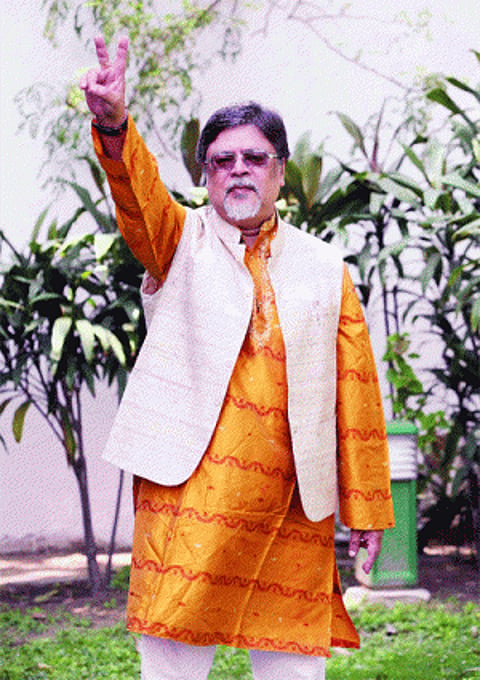

I never seriously believed this would happen to me. Despite my passionate interest in elections ever since I became a journalist in 1984, contesting a lok Sabha election was far from my ambitions. Although I covered virtually every lok Sabha poll till 1999, and numerous State Assembly elections through my 30 years in this profession and appeared in countless election analysis programmes on TV, the idea of becoming the news rather than reporting the news, never occupied my mindspace.
Over the years, many friends and family, however, often suggested I should take the plunge. They claimed I interacted well with ordinary people, empathised with them and usually struck a chord whenever I talked with them on a train, at airports and occasionally on the streets. But I argued back that such periodic interactions did not establish one’s popularity, especially because people recognised me from my TV appearances and, hence, were remarkably friendly, even deferential. Besides, elections were a different ball game in which personal likeability was hardly decisive in determining electoral choice.
But during the last lok Sabha poll in 2009, I was suddenly tempted by these proddings. Starting with my political mentor and senior BJP leader lK Advani, I tentatively sought a party nomination from the New Delhi constituency. This was once regarded as the most cosmopolitan seat in the country, which had elected non-natives such as CM Stephen and Mukul Banerjee (an unknown acolyte of Indira Gandhi), apart from Mr Advani and Atal Bihari Vajpayee, over the years.
Eventually, I was dissuaded by those in the know. They pointed to the change in the seat’s profile post-delimitation and also the staggering cost that no salaried professional could afford. I relented within two weeks of expressing my desire and “retired” in favour of Vijay Goel of my party. The results vindicated those who had advised me against contesting; sitting MP Ajay Maken won by over two lakh votes!
Of course, by then I was already a Rajya Sabha member, nominated by the President of India on the recommendation of Atal Bihari Vajpayee’s Cabinet for my “contribution” to the media. After my six-year term ended in 2009, I was named a candidate for a Rajya Sabha seat from Madhya Pradesh by my party for a second stint in the Upper House. My present term as MP lasts till July 2016. So there was no particular pressure to contest for the lok Sabha and plunge into the hurly-burly of electioneering.
But waiting in an ante-room in the BJP headquarters while the Central Election Committee met to clear names of candidates from different States (I was there in my capacity as Central Observer or Prabhari for Odisha), Bengal colleagues suddenly pressed me to give this election a shot. This happened when I said that if at all I were to contest I would do so only from Hooghly near Kolkata where my forefathers built a house nearly 150 years ago and where I lived till the age of eight, studying in two local schools. My father shifted base to Kolkata in 1963 and thereafter we would visit Hooghly regularly but did not live there again. A branch of the family, however, remains settled there and one floor of our sprawling ancestral home belongs to me as the only child of my parents.
Of late, destiny seems to be beckoning me there. For the last two years I have gone there on Makar Sankranti (January 14-15) for a holy dip in the Ganga on whose banks our house stands. In these years I renovated parts of the house and put in some modern gadgets to ensure better creature comforts to make our portion more liveable. But while getting all this done, I had not given the remotest thought to going back to Hooghly to contest the lok Sabha poll from there. But the enthusiasm of State party leaders and the bemused encouragement of my Central leaders (who applauded the “bold” move by a sitting Rajya Sabha member), finally made up my mind for me. On March 8, 2014, the BJP list of nominees from West Bengal had my name marked against No. 28 Hooghly lok Sabha.
So, off I went to Hooghly via Kolkata. With Atalji’s Golden Quadrilateral having drastically shortened travel time, it takes a flat 90 minutes to reach my ancestral home from the time you hit the Vidyasagar Setu or Second Hooghly Bridge in Kolkata. leaving luggage behind at home, I travelled back some 20 km to Bhadreshwar also on the banks of the Hooghly. This town is also part of the industrial belt along the river stretching from Howrah to Bandel on the right bank of the Hooghly. This belt comprises mostly once-thriving, British-owned jute mills, many of which have shut, rendering thousands jobless or are at best barely surviving on sarkari life support.
From the courtyard of the erstwhile coolie lines of the Angus Jute Mill in Bhadreshwar, I climbed on an open Tata 407 lMV, with some 30 party supporters packed like sardines around me. Raising full-throated slogans extolling qualities of BJP’s prime ministerial candidate Narendra Modi and my status as “bhumiputra” (son of the soil), BJP workers lent energy to the road show. Soon we crossed into the former French enclave of Chandernagore (now re-spelt Chandan Nagar).
Two historic pillars on either side of the Grand Trunk Road still stand, emblazoned with the emblem of the French Revolution of 1789, pronouncing liberte, Egalite, Fraternite (liberty, Equality and Fraternity). These words still resonate in all democracies and the Preamble of our own Constitution is embossed with these stirring principles.
Chandan Nagar, once a beautiful town with tree-lined boulevards and wide open spaces, is now indistinguishable from any other small town in West Bengal. Promoter-built matchbox-like apartments overhang the road originally built by Sher Shah Suri. I was surprised by the warm response I got along the road, people waved out from balconies or cheered from shop-fronts. looking towards the rear I found some 100 vehicles, apart from a large number of motorbikes flying the saffron and green BJP flag, following my vehicle, with some other bikes driving ahead as escorts. Stopping to acknowledge greetings and announce my candidature at every few steps, it took a long time to wind our way through this town.
By the time we reached our destination, the clock tower in the centre of the twin towns of Hooghly-Chinsura (Now spelt Chuchura), darkness had descended. With a brief address delivered without microphones (which are not permitted to be used till school examinations get over on March 30), we retired to the square’s well known tea-shop, the Banerjee Cabin. Hot tea and samosas were served at the restaurant by its owner, whose family is a supporter of our brand of politics.
This was followed by a bandobast meeting in a small one-room election office close by, which the party has hired as my election headquarters. We wound up around 9.30 pm, tired but elated by the success of the launch of my campaign. Hooghly is not one of BJP’s better seats in Bengal; in fact, few seats in the State would qualify as good for us. But I take it as a challenge hoping to change my original hometown’s electoral profile. It will be an uphill task, but then I am sure it will add a huge fund to my experience. And what’s life without thrills and challengesIJ
I will miss The Pioneer for a longish duration as I return to Hooghly immediately after Holi and propose to stay there till voting takes place on April 30. The paper will be in good hands in my absence --- of that I am sure. My supportive and experienced colleagues will ensure that its quality doesn’t suffer in any way.
Meanwhile, whenever I find time from what seems to be a gruelling six weeks ahead, I will try to bring to all readers of The Pioneer a feel of the heat, dust and excitement of the greatest elections on the face of this Earth.