
Maharashtra CM Devendra Fadnavis on Wednesday said that India is officially free of Naxalism, with Left Wing Extremism (LWE) having been completely wiped out and no district now affected. In a post on X, he said: “This is huge! Congratulations India! We are now officially Naxal-free India! From Guns to Governance, from Fear to Freedom, from Extremism to Empowerment!! Only the Modi Govt could have done this! Under the leadership of Hon. PM Narendra Modi Ji and the guidance of Hon. HM Amitbhai Shah, LWE has been completely eradicated, with no district affected!
Fadnavis spoke of the transformation of Gadchiroli in Maharashtra, once a major Naxal area and now Naxal-free and on the way to becoming the next steel hub. He called the district a model of peace, development, and trust, and paid tribute to the security forces, the police, and the people of Gadchiroli who have chosen the path of peace and progress.
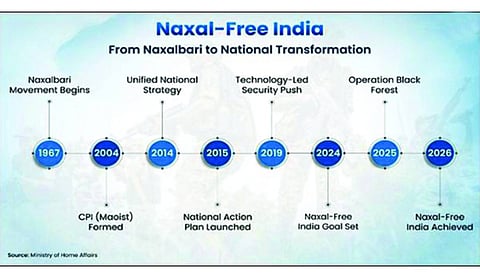
The statement aligns with the Centre’s position that India had effectively become free from LWE by 31st March 2026 (the date set in August 2024). Official figures show that the number of LWE-affected districts fell from 126 in 2014 to zero by March-April 2026. The number of incidents of violence has fallen from 870 in 2014 to 33 by the end of July 2026, and the number of deaths related to the issue has dropped from 310 to 12. Around 8,500 cadres have now surrendered under the rehabilitation schemes.
The movement’s demise marks the end of a struggle that began with the Naxalbari uprising in West Bengal in 1967 and then expanded into what became known as the ‘Red Corridor’ across central and eastern India. At its height, the Maoists had control over vast tracts of forested tribal areas, running parallel forms of administration, collecting taxes from miners and contractors and carrying out ambushes and landmine attacks which took the lives of thousands of people (both civilians and security forces).
The turnaround resulted from the National Policy and Action Plan to deal with LWE, launched in 2015: this comprehensive plan combined security operations, infrastructure development, recognition of tribal rights, and rehabilitation. Several specialised units operated, including CoBRA, Greyhounds, District Reserve Guard, and Maharashtra’s
C-60 commandos.
The major campaign was Operation Black Forest in the Karreguttalu Hills along the Chhattisgarh-Telangana border in 2025, which resulted in the elimination of the top leadership (all of the senior Central Committee members), the destruction of hideouts and arms factories and the destruction of the stock of explosives and IEDs. All of the Politburo and Central Committee members of the CPI (Maoist) have been neutralised since 2014.
Parallel development efforts went a long way to re-establish the state in the hinterlands. Dedicated schemes built over 15,000 km of road, commissioned nearly 9,500 mobile towers, and expanded banking and post office services.
The Government issued over 21 lakh individual and community forest rights. Security camps were turned into service centres, and surrendered cadres received financial assistance, skill development, and employment support.
In Gadchiroli, steel companies have accelerated the move through investments and the recruitment of local youth into the police. The transition from a conflict area to an area of industry and governance is well underway.
From Guns to Governance: India’s Naxal chapter closed, says Fadnavis
PM Modi and Home Minister Amit Shah had earlier described the country as being free from Naxalism and Maoist terror during the ‘Janjatiya Gaurav Diwas’ events in Gadchiroli in mid-November, connecting the end of the violence with the large number of tribal development projects that had been undertaken.
With armed extremism now eliminated, the focus has shifted to consolidating gains in the 37 “Legacy and Thrust” districts through further development, welfare saturation, and surveillance to prevent a revival.
Gadchiroli is a good example of the shift Fadnavis described, from a theatre of insurgency to a potential steel hub. The complete erasure of the LWE-affected districts after 60 years is a major internal security win for India, achieved through a combination of security pressure, development, and the gradual erosion of local support for the movement.
