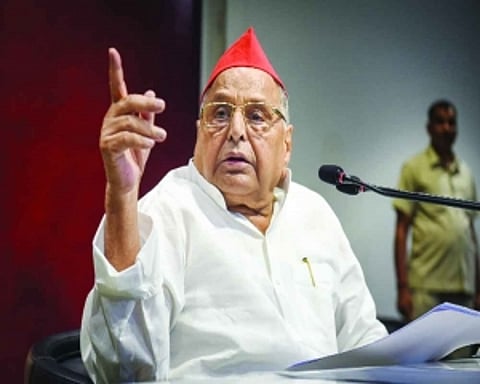

Samajwadi Party founder and three times Chief Minister of Uttar Pradesh Mulayam Singh Yadav died at the age of 82 after prolonged illness.
He had been admitted to a private hospital at Gurugram for more than a fortnight. During his long political career, Mulayam was elected to the UP Assembly for eight terms and seven times to the Lok Sabha from three constituencies — Mainpuri, Sambhal and Azamgarh. His wife, Sadhna Gupta, died on July 9 last.
After Mulayam’s condition deteriorated, he was put on a ventilator. His son and political successor Akhilesh Yadav announced his death on Monday morning.
Politicians across party lines, public figures and members of the public have paid tributes to one of the stalwarts of Indian politics. Prime Minister Narendra Modi led the tributes with a tweet, remembering his meetings with the veteran leader. Union Home Minister Amit Shah laid a wreath on the body of Mulayam at the private hospital in Gurugram.
UP Chief Minister Yogi Adityanath and Bharatiya Janata Party State president Bhupendra Singh Chaudhary reached Saifai in Etawah district to pay their tributes to the departed leader. Deputy Chief Ministers Keshav Prasad Maurya and Brajesh Pathak also expressed grief at the death of Mulayam.
Adityanath on Monday rushed to Saifai as Prime Minister Modi will be there to attend the cremation of Mulayam on Tuesday.
The Congress, the main Opposition party in both Houses of Parliament, said in a tweet in Hindi that Mulayam’s “death was an irreparable loss to Indian politics”. Former Congress president Rahul Gandhi in the midst of Bharat Jodo Yatra paid floral tribute to Mulayam.
A former Defence Minister, Mulayam had been unwell for the past few years and was constantly in and out of hospitals. He was a sitting MP from Mainpuri but was not very active and was rarely seen in public. He leaves a rich and controversial legacy behind as his regional Samajwadi Party (SP), now led by Akhilesh, continues to be a prominent player in the politics of Uttar Pradesh. Like most strong regional leaders, he held the ambition to become India’s Prime Minister, but that dream remained unfulfilled.
Mulayam belonged to a generation of leaders who were born out of mass movements. In 1989, when he became UP’s Chief Minister for the first time, the slogan “Jiska jalwa kayam hai, uska naam Mulayam hai” was on the walls of Lucknow. He was known as a master strategist and his political moves kept both allies and opponents guessing.
He astutely mixed regional and national politics to remain relevant throughout his active career. His drive —combined with the skill to bounce back from seemingly hopeless political setbacks — made him a formidable adversary in Uttar Pradesh, India’s most populous State.
Since a bitter rift between his brother Shivpal Singh Yadav and his son Akhilesh split his party SP in 2017, he largely remained away from the limelight.
A former wrestler, Mulayam was known to pin his political opponents down with his understanding of grassroots politics and his ability to connect with the masses. At the same time, he had friends in most political parties.
But he was also prone to political gaffes. While campaigning for the 2014 general election, he said that rape accused should not be hanged as “boys make mistakes”. He later clarified that he was actually asking that anti-rape laws to be applied judiciously. But his clarification did not stop campaigners from criticising him and questioning his stand on women’s rights.
Trained as a teacher in his home village Saifai in Etawah district of central Uttar Pradesh, Mulayam took the plunge into politics at the age of 15. Influenced by the writings of socialist ideologue Ram Manohar Lohia, he took part in several agitations led by Lohia.
He became the youngest member of the UP Assembly when he contested election in 1967 as a Socialist Party candidate. He was elected in 1974 and again in 1977 on Janata Party ticket, formed the same year after lifting of the Emergency clamped by the then India Gandhi regime in June 1975. He was inducted as a Cabinet Minister and given the cooperative department portfolio in the Government headed by Ram Naresh Yadav.
Typical of the mercurial nature of his career were the elections of 1980 when, for the first time, he lost amid a surge of support for the Congress party. Jat leader Chaudhary Charan Singh came to his rescue and he was elected to the Upper House of the UP legislature where he was later elevated as the Leader of the Opposition.
A few years later he took the unusual step of getting elected to the Lower House of the UP legislature as well in the 1985 UP Assembly elections. He is the only leader to have achieved the distinction of holding the position of Leader of Opposition in both the Houses of UP legislature.
His first stint as UP Chief Minister -- from 1989 to 1991 -- was short-lived but not uneventful. The call for kar sewa given by the Vishwa Hindu Parishad in October 1990 led to police firing in Ayodhya. The police opened fire twice on October 30 and November 2. The incident earned him the label of “Mullah Mulayam”.
In October 1992, Mulayam floated his own political party-the SP. The SP contested the 1993 Assembly election in alliance with the Bahujan Samaj Party (BSP). The alliance collapsed in June 1995 and the Mulayam Government was dismissed by then Governor Motilal Vora.
In August 2003, Mulayam took over as Chief Minister for the third time. The SP lost the 2007 UP Assembly election and its bitter foe BSP for the first time formed the Government with a clear majority. The SP bounced back and won the 2012 UP Assembly election and Mulayam installed his son Akhilesh as the Chief Minister. It was seen as a decisive attempt by “Netaji” to settle the issue of succession in the first family of the SP. Though Akhilesh is now the undisputed leader of the SP, his estranged uncle Shivpal is yet to reconcile to the succession plan implemented by his elder brother Mulayam a decade ago in 2012.