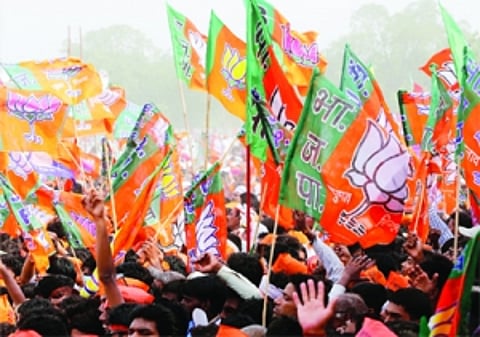

Communal and caste polarisation is a bitter reality of the electoral battle in Bihar, but a section of people is also eager to break the age-old ghettos and place the future of the nation before their narrow interest. This ginger group can play a decisive role in deciding the overall electoral outcome in Bihar despite the divisive mobilisation that has marked successive elections post mandal and kamandal era in north India.
If an “unreliable” Ram Vilas Paswan, or an “aloof” Rajiv Prasad Rudy or a former muscleman Rama Singh could hope to win the battle of ballots, then it is primarily because a powerful section of OBCs and EBCs voters are flocking to the NDA to strengthen the hands of BJP’s prime ministerial candidate Narendra Modi to “rebuild” the nation. It will be safe to conclude that such churnings are taking place not at any big scale, but they can have a huge effect on the poll result.
Going by the caste arithmetic, the NDA could not hope to reach double digit figure in Bihar. The BJP has traditionally been a party of upper castes in Bihar despite OBC leaders like Sushil Kumar Modi and Nand Kishore Yadav being its face in the State.
Of course, both of them have good appeal across the caste barrier in Bihar, but not enough to convert the 11 per cent upper caste vote bank into a decisive factor. Even if one makes provision for the six per cent Paswans, who owe allegiance to Ram Vilas Paswan, and some Koeri voters, who could follow their supreme leader and NDA ally Upendra Kushwaha, the alliance could barely hope to reach 20 per cent votes.
But there comes the pro-change voters who want to dump the baggage of the past and make a new beginning. In many cases, it is clear that voters belonging to extremely backward castes and even a section of the Yadavs and OBCs are ready to votes for the NDA candidates. Ask why, and they universally talk about the UPA misrule, price rise and the all-pervasive atmosphere of despair that has engulfed the nation.
“This time, we are voting to elect a Prime Minister who has promised to change the fate of the nation,” said Ramesh Das, a Dalit in Seetalpur in Saran district. Grill him on what he knew of Modi or what specifically he expected him to do, the youth nods his head. “I don’t know what he has done in Gujarat or what he’ll do in Delhi, but he talks a like man — at least, not like Manmohan Singh,” he says.
The anger against the UPA is twofold. First is directed against the slew of corruption charges it faced, and the second relates to the “image” of the Prime Minister — a weak and helpless man, who is ready to make all compromise to stay in office. A section of people is so outraged at the UPA’s performance and the PM’s failure to uphold the dignity of his office that they are ready to go to any extent to “teach a lesson” to the Congress and its allies. So, if the caste barriers are even developing a chink, it is for positive agenda of “change for the better’ and not to back someone like lalu Prasad, who has been able to unquestionably insulate a large chunk of his M-Y combination from the Modi factor.
But the same has not been the case with Nitish Kumar. The Bihar Chief Minister is struggling to protect his assiduously nurtured EBC vote bank, which is veering towards the NDA in many places. It’s not because they are unhappy with Nitish, but because they see Modi as a game changer at the national level. The EBC voters are not convinced that despite his claim of being better qualified than Modi or Rahul Gandhi to lead the nation as PM, Nitish could occupy the high office as a leader of the Third Front even if they vote overwhelmingly for him. In such a scenario, a section of the EBC voters is ready to join hands with the NDA to dent the prospect of the UPA’s return to power. “Since Nitish can’t be PM, we will vote to make Modi our PM,” said Ramendra Kumar of Vaishali.
A paanwala, he sees no contradiction in his belief and his action. Asked how he could support Modi when he keeps criticising Nitish Kumar, the man laughs. “Yeh sab politics me hota hai. Dono acche neta hain aur age chal kar phir sath aa jayengey.” Even in case of Yadavs, while lalu has been able to galvanise them in a big way, but at places one can detect the first signs that the fountainhead of the OBC empowerment is now ready to embrace the winds of change.
“Gone are the days when we danced to the tune of lalu Prasad,” says Parvesh Rai, an unemployed youth in Sonepur. “He does not care for anyone but his family.” Of course, two other Yadavs shouted him down, but in several places in Hajipur, Saran and Vaishali one could get unmistakable signals that the caste divide is becoming narrower in Bihar despite every attempt by the political class to widen it. Voters, specially the first time ones, and the youth, wants better jobs and better life. So they have reason to rise over caste lines and croon “ache din aane wale hain.”