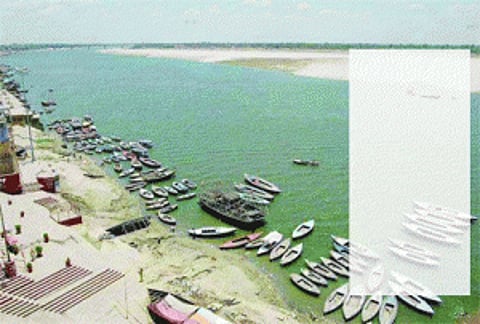

To boost trade activity on waterways by improving the river information systems, the Government has started installing Differential Global Positioning System (DGPS) all along National Waterway-1 & 2.
National Waterway-1 runs from Haldia-Allahabad-Patna along Ganga, Bhagirathi and Hooghly rivers, while National Waterway-2 Aruns along the Brahmaputra River between the Bangladesh border and Sadia in Assam.
Seven base stations with monitoring systems to oversee movement of commercial vessels on the Haldia-Farakka waterway stretch are functional, giving the inland waterways project a push as it will help build trader confidence through enhanced security.
The total cargo moved by inland waterways is just 0.1 per cent of the total inland traffic in India. The inland waterway project is aimed at increasing the volume of waterway traffic five times from the existing 611 million tons in five years. This will reduce pressure on both rail and road traffic.
The Government has also started transshipment of imported coal to the National Thermal Power Corporation’s Farakka Thermal Power Station through National Waterway-1 consequent to the tri-partite agreement between NTPC, Inland Waterways Authority of India (IWAI) and Jindal ITF.
Close to 21 million tons of imported coal is expected to be moved in the next seven years on this waterway. Movement of fertilizers upstream for Tata Chemicals ltd and downstream for IIFCO on National Waterway-1 recently has been another success story.
Earlier this year, Finance Minister Arun Jaitley in his Budget speech had announced that a project on the river Ganga called Jal Marg Vikas - National Waterways 1 would be developed between Allahabad and Haldia with the assistance of the World Bank to cover a distance of 1,620 km, which would enable commercial navigation of at least 1,500 ton vessels.
The project is expected to be completed over a period of six years at an estimated cost of `4,200 crore.
“The initial project related activities are in full swing. We are also looking at PPP models for the construction of terminals, operation and maintenance as well as monitoring,” said P Radhakrishnan, Minister of State for Shipping, Road Transport and Highways. He was speaking at a workshop on Integrated National Waterways Transportation Grid.
“The Government is working to build a world-class Inland Water Transport (IWT) system in the next five years. We want to reduce investment needs in rail and road infrastructure, enhance intra-regional trade and through increased economies of scale, significantly reduce transport costs by building a robust inland waterway network,” he said.
Radhakrishnan said that the IWAI is engaged in the process of policy initiatives on modernization of best practices, safety, increasing cargo movement and introducing contemporary river conservancy and training methodologies.
“Consultancy to State Governments in building their capacity for handling waterways is high on the future agenda of IWAI,” said Radhakrishnan.