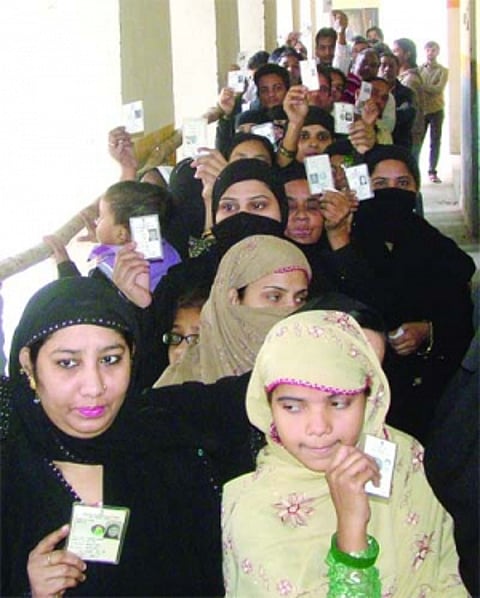

Even as the national Capital registered its highest-ever voter turnout of 65.13 per cent in the keenly contested Assembly polls held on December 4, the uneven polling in around 10 constituencies is noteworthy.
While Seemapuri registered the highest turnout of 72.19 per cent, the Muslim-dominated Ballimaran saw the lowest voting percentage of 56.2 per cent. However, only the keenly contested Assembly constituencies recorded higher voter turnout. Postal ballots too registered a record with 43,015 Government officials on poll duty exercising their franchise; in the 2008 Assembly polls it stood at mere 1,600.
Seemapuri, Gokalpur, Mustafabad, Sadar Bazar, Tri Nagar were top five constituencies which recorded above 70 per cent polling, while Ballimaran (56.2%), Janakpuri (56.27%), Badli (59.3%), Rajinder Nagar (59.67%), and Delhi Cantt (59.69%) were the bottom five constituencies in terms of voter turnout.
Inflation, corruption, women’s safety and problems associated with unauthorised colonies were the main issues for the voters of North-East district. The high voting percentage in Delhi can be attributed to anti-incumbency in Delhi coupled with a successful awareness campaign conducted by the Election Commission.
Total turnout in the prestigious New Delhi seat was 65.95 per cent as Congress candidate and three-time Chief Minister Sheila Dikshit faced formidable challenge from Aam Aadmi Party leader Arvind Kejriwal. In BJP’s chief ministerial candidate Dr Harsh Vardhan’s constituency, the polling percentage was 67.52 per cent.
As compared to the voter turnout in Mizoram, Rajasthan, Madhya Pradesh and Chhattisgarh’s Assembly elections, the poll percentage in national Capital was the lowest, but the difference from the last election in Delhi was higher than those of the other four States. Out of the total 1.19 crore electorate, a whopping 77.7 lakh voters exercised their franchise. In 2008, the overall voting percentage in Delhi was 57.58 per cent, while it stood at 53.4 per cent in 2003. In 1998, merely 43.9 per cent voters had cast their votes.
Women constituted 44.28 per cent of the total voters who exercised their franchise. Women voters came in full force in RK Puram, Malviya Nagar, Mangolpuri, Narela, Mundka, Seemapuri, Gokalpur and Mustafabad. For the first time in Delhi, about 8,000 homeless, 1,500 sex workers and 562 transgenders were brought under the ‘others’ category. Out of the 562 transgender voters, 207 exercised their right.